AI knitting pattern generators create complete, custom-fitted patterns in under 5 minutes — a process that traditionally takes 2–6 hours of manual calculation. These tools analyze a reference photo, apply your body measurements and yarn gauge, and produce row-by-row instructions you can follow straight to your needles. Among the 53+ million knitters in the US alone, tools like La Maille are fundamentally changing how custom patterns are created and who gets to create them. Here's an honest, in-depth comparison of both approaches to help you decide which method — or combination of methods — is right for your projects.
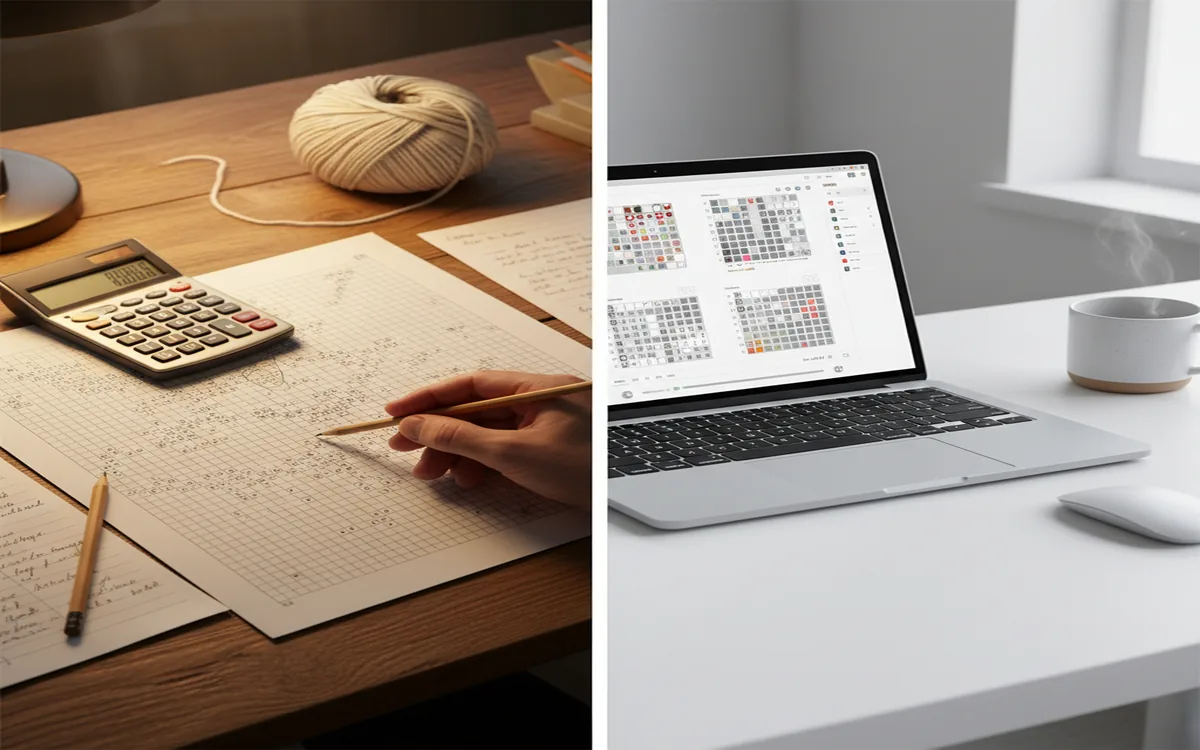
Traditional Pattern Creation: The Craft Approach
For decades, knitters who wanted custom patterns had two options: buy a published pattern and modify it, or design from scratch using math and experience. Both routes demand a real investment of time and knowledge — but they also reward you with a deep understanding of how garments are built from the ground up.
How Traditional Pattern Design Works
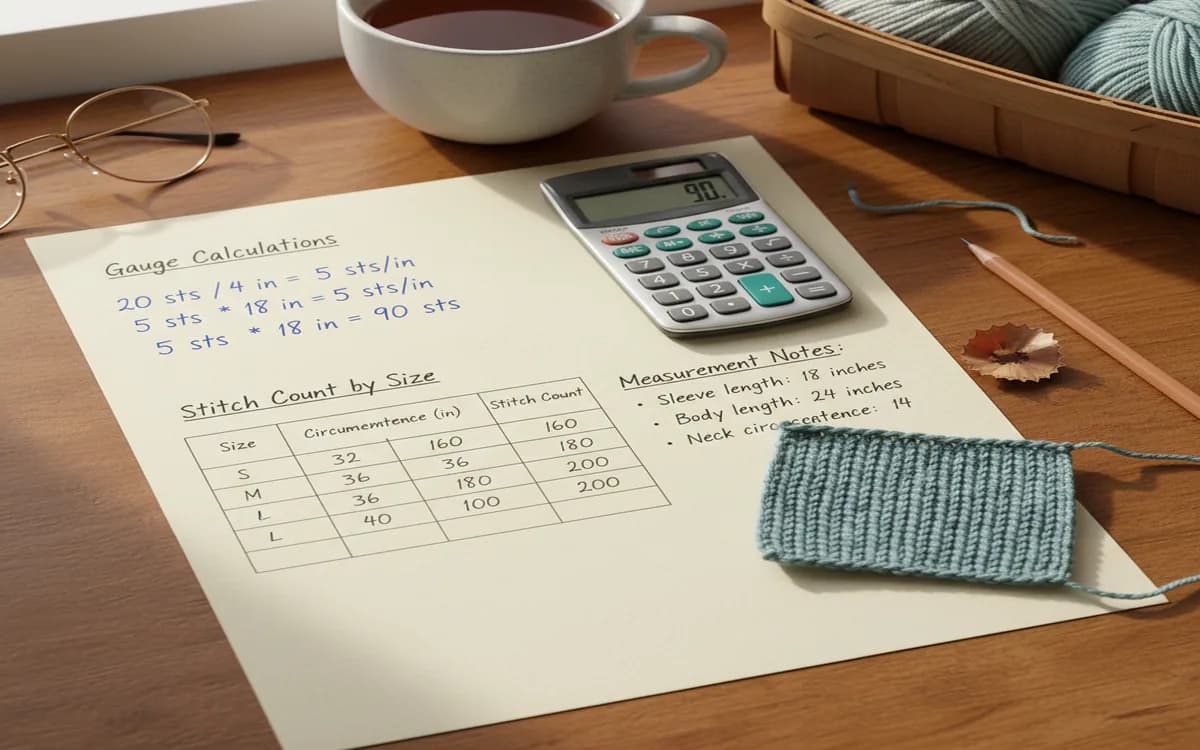
Modification approach: Start with an existing pattern that's close to what you want. Adjust stitch counts for different sizes, change the neckline shape, add or subtract length, or swap in a different stitch pattern. This approach requires you to understand how the pattern is constructed at a structural level, because changing one element — say, adding 2 inches of positive ease across the chest — ripples outward into the sleeve cap height, the armhole depth, and potentially the neckline width. A seemingly simple change can involve recalculating a dozen interdependent numbers.
From-scratch approach: You decide on a construction method (top-down raglan, set-in sleeve, yoke, drop shoulder), take your body measurements, knit a gauge swatch, and then work out every single stitch count and shaping instruction mathematically. If your gauge is 20 stitches and 28 rows per 10 cm, and you want a chest circumference of 96 cm with 5 cm of positive ease, you need to cast on approximately 202 stitches for a seamless round yoke — and that's before you've calculated the yoke depth, the sleeve stitches, or the neckline decreases. Experienced designers often build spreadsheets or use specialized software like Stitchmastery or KnitBird to manage the volume of calculations and reduce human error.
Pros of Traditional Methods
Complete control: You decide every detail — construction method, exact ease, specific shaping techniques, finishing methods, and the precise wording of every instruction.
Deep understanding: Working through the math teaches you why a pattern works, not just how to follow it. Knitters who design their own patterns tend to be far better at troubleshooting fit issues and modifying published patterns.
No technology required: A pencil, graph paper, and a basic calculator are genuinely all you need to design a garment from scratch.
Established techniques: Decades of collective knowledge have been refined and passed down through books, workshops, and knitting communities. There is a rich body of wisdom about what shaping works for which body type, which construction methods suit which yarn weights, and how to write instructions that other knitters can follow.
Offline and portable: Traditional design can happen anywhere — on a train, in a waiting room, or in a mountain cabin without wifi.
Cons of Traditional Methods
Time-intensive: Creating a pattern from scratch realistically takes 2–6 hours for an experienced designer, and significantly longer for someone newer to pattern math. A complex colorwork yoke with custom sizing could take days.
Steep learning curve: You need solid arithmetic skills, an understanding of garment construction, and experience reading and troubleshooting patterns before you can reliably design your own.
Error-prone: A single miscalculation — say, rounding 20.4 stitches to 20 instead of 21 at a critical point — can throw off an entire sleeve or create a neckline that's too tight to pull over your head. Errors compound across a garment.
Intimidating for intermediate knitters: Many knitters who are perfectly comfortable following complex patterns never attempt designing their own because the math feels overwhelming. This is a genuine barrier that keeps creative ideas from becoming real garments.
AI Pattern Generation: The Modern Approach
AI knitting pattern generators like La Maille use machine learning to analyze images and produce fully calculated patterns automatically. You provide a photo of a sweater you love, your body measurements, and your yarn's gauge — the AI handles every calculation and delivers row-by-row instructions you can cast on immediately.
How AI Pattern Generation Works
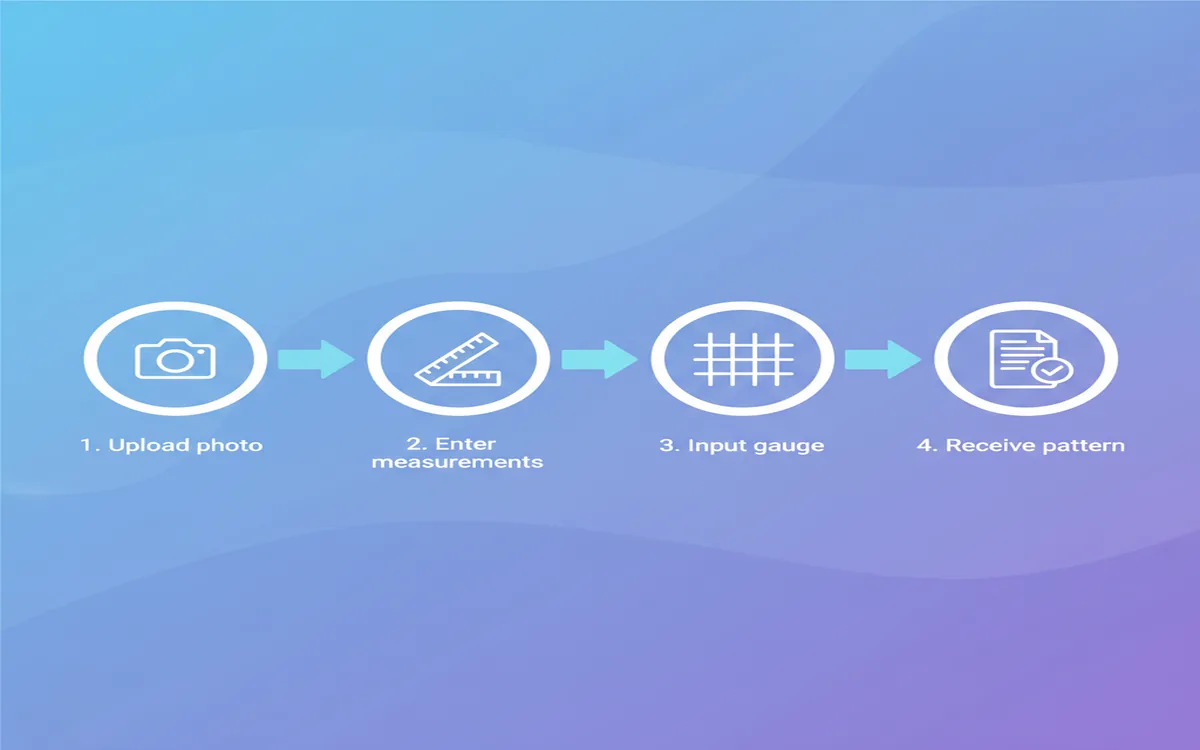
Image analysis: The AI examines your reference photo to identify the construction type (raglan, set-in sleeve, drop shoulder, circular yoke), the silhouette (fitted, oversized, cropped, longline), and the proportions of each section relative to the whole.
Measurement mapping: Your body measurements — bust, waist, hips, sleeve length, body length, and desired ease — are used to calculate the precise dimensions of every pattern piece.
Gauge calculations: Your stitch gauge and row gauge (measured from your actual swatch in your chosen yarn) determine every stitch count and row count throughout the pattern. A generator that ignores row gauge is missing half the equation.
Pattern generation: The AI produces complete, row-by-row written instructions — cast-on counts, increase and decrease schedules, bind-off instructions, and finishing notes — based on all of the above data, assembled into a coherent pattern you can follow from beginning to end.
Pros of AI Pattern Generation
Speed: A complete, gauge-accurate custom pattern in 5 minutes or less, compared to hours of manual work.
Accessibility: No advanced math or garment construction experience required. If you can knit a gauge swatch and take a body measurement, you have everything you need.
Consistency: The AI doesn't make arithmetic errors or accidentally round in the wrong direction. Every stitch count follows logically from the measurements and gauge you provided.
Photo-based design: See a sweater on Instagram, in a film, or in a shop window? You can upload a photo and receive a pattern for it, without spending hours trying to reverse-engineer someone else's design.
Easy iteration: Want to test three different ease levels — 5 cm, 8 cm, and 12 cm — to decide which silhouette you prefer? Regenerating with new measurements takes seconds, not hours. This makes it genuinely practical to experiment before you commit to a project.
Sizing flexibility: Custom fit for your specific body, not a generic size chart. This is particularly valuable for knitters whose measurements fall outside standard size brackets.
Cons of AI Pattern Generation
Less granular control over technique: You may not be able to specify exactly which increase method to use (M1L versus lifted increase, for example) or request a specific neckline shaping style you've learned to prefer.
Technology dependent: Requires internet access and a functioning tool. Not suitable for a remote cabin knitting retreat without connectivity.
Learning curve for best results: Getting the most accurate output requires submitting clear photos, precise measurements, and an accurately measured gauge. Garbage in, garbage out — a blurry photo or a swatch measured with stretched yarn will produce a less reliable pattern.
May need manual tweaking: AI-generated patterns for unusual or highly complex designs — dramatic asymmetry, intricate construction methods, highly textured stitch patterns — may require some manual adjustment before they're ready to knit.
Feature Comparison
| Feature | Traditional | AI Generation |
|---|---|---|
| Time to create pattern | Hours to days | Minutes |
| Math skills required | High | None |
| Design experience needed | Significant | Minimal |
| Customization level | Complete | Moderate |
| Works from photos | With effort | Yes |
| Cost | Free (your time) | Varies by tool |
| Accuracy | Depends on skill | Consistent |
| Offline capability | Yes | No |
| Iteration speed | Slow | Very fast |
When to Use Traditional Methods
Traditional pattern design is ideal when:
You want a specific construction technique that you know well and want to execute precisely — for example, a steeked colorwork cardigan or a heavily cabled Aran with custom panel placement.
You're designing for publication and need complete control over every instruction, from cast-on method to blocking recommendations.
You enjoy the math and problem-solving aspect of pattern design and find it creatively satisfying in its own right.
You're making significant modifications to an existing pattern and need to understand all the interconnected changes to ensure the proportions hold together.
You're working offline or prefer paper-based planning that you can annotate, sketch on, and carry with you anywhere.
You're teaching others about garment construction and want them to understand the underlying logic, not just follow generated output.
When to Use AI Pattern Generation
AI tools shine when:
You see a sweater and want to recreate it without spending hours on structural analysis and stitch count math.
You're an intermediate knitter who is comfortable following patterns but hasn't yet built the design math skills for from-scratch creation.
You value speed and would rather spend your limited knitting time actually knitting, not calculating.
You want to try multiple variations quickly — different sizes for different recipients, different ease levels, or slightly different proportions — before deciding which version to commit to.
You're confident in your ability to read and adjust a generated pattern if small tweaks are needed, using your knitting knowledge to make targeted changes.
You want a custom fit without paying for a private designer — AI generation puts bespoke sizing within reach for everyday projects, not just special commissions.
The Hybrid Approach
Many experienced knitters find the best results come from combining both methods intelligently. Rather than treating them as opposites, think of them as tools you reach for at different stages of a project.
1. Use AI to generate a base pattern from your reference photo and measurements — get the structural math done in minutes. 2. Review the pattern with your knitting knowledge, checking that the stitch counts and shaping sequences make sense to you. 3. Modify specific elements — maybe you prefer a German short-row shoulder to a standard bind-off, or you want to add waist shaping that wasn't in the original design. 4. Knit a test swatch or a small section to verify the fit before committing to the full project. 5. Annotate as you go — note what you changed and why, so you can reproduce the adjustments in future projects.
This approach gives you the speed and accessibility of AI generation combined with the precision and control of traditional methods. It's particularly effective for knitters who are actively developing their design skills — the AI handles the heavy arithmetic while you focus on the craft decisions.
Quality Considerations
Not all AI pattern generators are created equal, and the differences matter significantly for the finished result. Key questions to ask before committing to any tool:
Does it generate complete patterns or just charts? Many tools on the market only create colorwork charts or stitch pattern grids, not full garment patterns with complete shaping instructions. Know what you're getting.
Does it adapt to your actual gauge? A quality generator adjusts every stitch count and row count based on the gauge you measured from your specific yarn and needles — not just a standard gauge associated with a yarn weight category. This distinction is critical for accurate fit.
How detailed are the instructions? Look for row-by-row written guidance with specific stitch counts at each stage. Vague descriptions like "work increases until piece measures desired length" are not sufficient for reliable results.
What construction methods does it support? Some tools handle only basic drop-shoulder or raglan constructions; others can manage set-in sleeves, circular yokes, saddle shoulders, and more. The wider the range, the more versatile the tool.
What does it do with unusual body measurements? A strong generator handles a 30 cm difference between bust and hip gracefully, rather than simply scaling a standard shape up or down uniformly.
La Maille, for example, generates complete patterns with row-by-row instructions adapted to your specific gauge — not just colorwork charts or approximate sizing frameworks.
The Future of Pattern Design
AI pattern generation is still a relatively young technology, and the tools are improving at a rapid pace. In the near future, we're likely to see:
- More accurate recognition of complex stitch patterns, including cables, lace, and textured knits
- A wider range of supported construction methods, including advanced techniques like contiguous sleeves and modular construction
- Integration with yarn databases for automatic weight and yardage recommendations based on your pattern
- Real-time fit adjustment tools that let you tweak measurements interactively and see updated stitch counts immediately
- Collaboration features that let you share AI-generated patterns with a knitting community for feedback before you cast on
But traditional pattern design isn't going anywhere. The deep understanding it provides remains genuinely valuable, and many knitters find the process of working through the math deeply rewarding — a form of creative problem-solving that's part of what makes knitting so engaging as a craft.
Making Your Choice
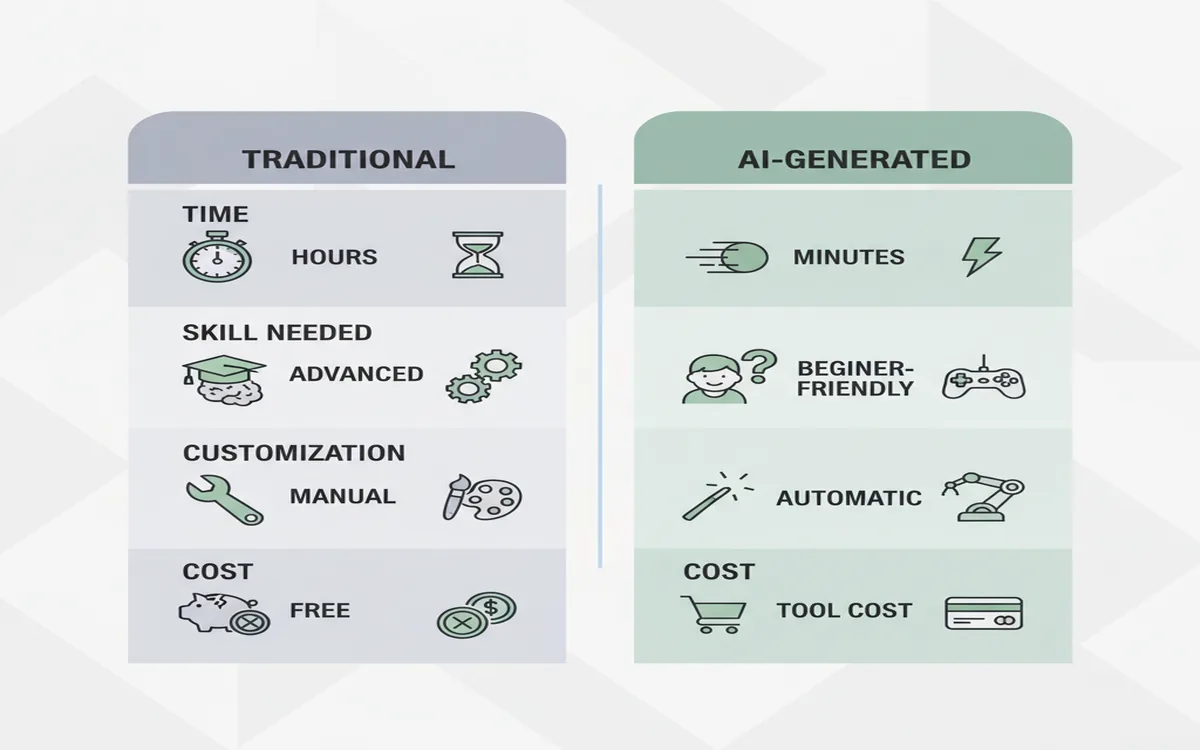
There's no wrong answer here. Your choice depends on your available time, your experience level, how much you enjoy the design process itself, and what kind of project you're making. A quick handknit gift for a friend with an unusual size? AI generation is an obvious win. A once-in-a-decade heirloom sweater where you want every detail precisely as you imagined it? Traditional methods may feel more satisfying.
Most importantly, try both approaches on different projects. You might find you reach for AI generation for quick, practical everyday knits and reserve traditional methods for the projects where the design process itself is part of the pleasure.
Frequently Asked Questions
What is an AI knitting pattern generator? An AI knitting pattern generator is software that analyzes a reference photo and your body measurements to automatically calculate and produce a complete knitting pattern, including cast-on counts, shaping instructions, and row-by-row guidance — without requiring any manual math from the knitter. The best tools adapt every stitch count to your specific yarn gauge, producing patterns that are custom-fitted to your body and your materials.
Is AI pattern generation better than traditional methods? Neither is inherently better — they serve different needs. AI generation is significantly faster (5 minutes versus 2–6 hours) and accessible to knitters without advanced math skills. Traditional methods offer complete control over every technical detail and build a deeper understanding of garment construction. Many experienced knitters use both, depending on the project.
Do AI pattern generators work for all sweater styles? Most quality AI generators handle the most common constructions: raglan, set-in sleeves, drop shoulders, and circular yokes. Complex or unusual designs — heavily asymmetrical silhouettes, intricate modular constructions, or garments with multiple unusual design elements — may require some manual adjustment after generation. Coverage is improving rapidly as the technology develops.
How accurate are AI-generated stitch counts? When you provide an accurate gauge swatch measurement (taken from a properly washed and blocked swatch, not from the needle before washing), a quality AI generator will produce stitch counts that are mathematically consistent and correctly proportioned to your measurements. The main variable is the accuracy of the inputs: precise measurements and gauge produce precise patterns.
How much does AI pattern generation cost? It varies by tool. La Maille offers free pattern generation during its beta period, making it a risk-free way to try AI-generated patterns before committing. Traditional methods cost only your time, but require pattern math skills that themselves take time and practice to develop.
Can beginners use AI knitting pattern generators? Yes — AI generators are specifically accessible to knitters who don't yet have garment design experience. You need two things: an accurate gauge swatch from your chosen yarn and needles, and your body measurements. Both are skills any knitter can learn with a bit of practice. The AI handles all the calculation complexity so you can focus on the knitting itself.
What measurements do I need to use an AI pattern generator? At minimum, most tools need your bust circumference, your desired body length, and your sleeve length. More detailed tools will also ask for your waist, hip, upper arm circumference, and your preferred ease (the difference between your body measurement and the finished garment measurement). The more precise your inputs, the better your pattern will fit.
Ready to try AI pattern generation? Upload a photo to La Maille and see a complete custom pattern in under 5 minutes.