Reading a knitting pattern means decoding a precise written language: abbreviations like K (knit), P (purl), and YO (yarn over), size notations presented in parentheses, and repeat markers like asterisks that tell you how many times to work a sequence. Most patterns follow a predictable structure — header information, gauge, stitch-by-stitch instructions, and supporting materials like schematics and charts. Pattern literacy is the gateway skill to independent knitting. Whether you're following a free Ravelry download, a published book pattern, or a custom design generated by La Maille, this guide teaches you to read any knitting pattern with confidence and precision.
Anatomy of a Pattern
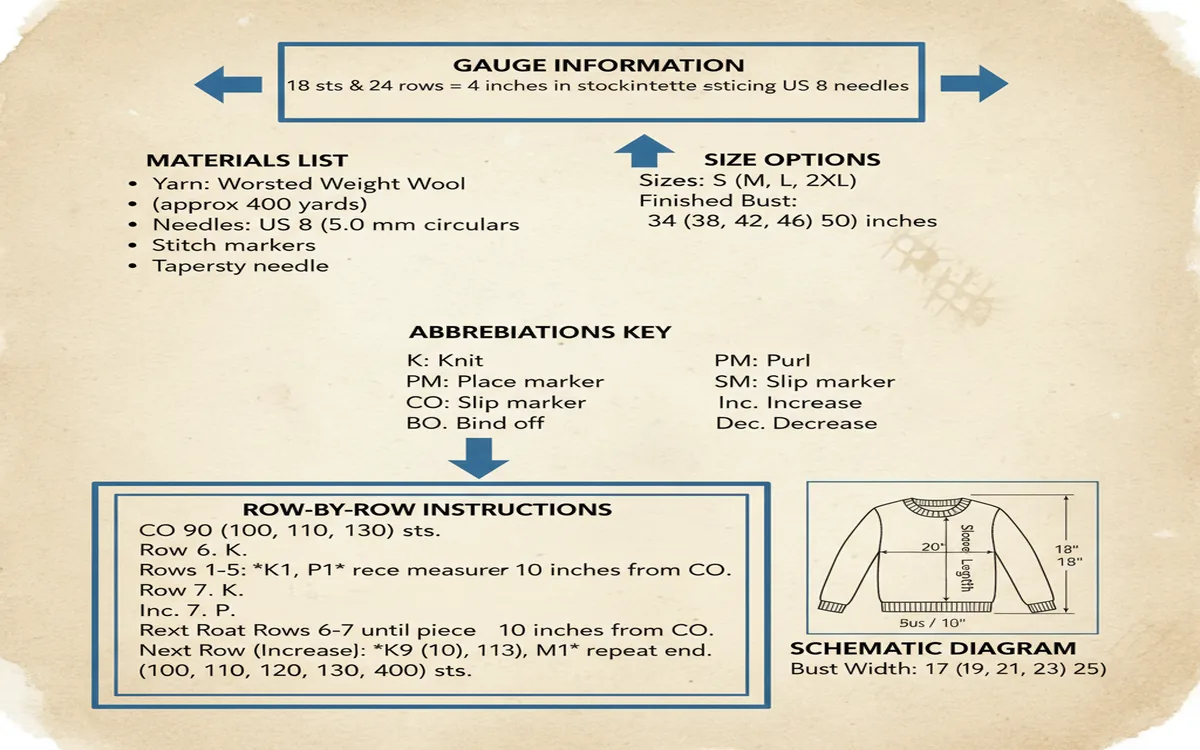
Every well-written knitting pattern is built from the same core sections. Once you know where to look for each piece of information, navigating a new pattern becomes much faster — even when the writing style or format differs from what you're used to.
Header Information
Skill level: Usually labeled Beginner, Easy, Intermediate, or Advanced. Be honest about where you are. A pattern rated Intermediate typically assumes you can work decreases, increases, and read basic charts without step-by-step explanation.
Finished measurements: The actual dimensions of the completed garment or accessory. This is what the item will measure after blocking, not while it sits on the needles. For sweaters, you'll typically see chest circumference, body length, and sleeve length. For a hat, you'll see circumference and height. Always compare finished measurements to a garment you already own and love the fit of.
Materials needed: Yarn (listed by weight, fiber, and total yardage required), needle sizes in both US and metric, and notions — things like stitch markers, a tapestry needle for seaming, cable needles, or a stitch holder. Never skip this section; running out of yarn mid-project because you didn't check yardage is one of the most common beginner mistakes.
Gauge: The number of stitches and rows per 4 inches (10 cm) that the pattern is designed around. This is, without question, the most important number in the entire pattern. We'll return to gauge in its own section.
The Instructions
Cast on: The number of stitches to start with, and often the recommended cast-on method. Some patterns specify a long-tail cast on for stretch, or a cable cast on for structure. When no method is specified, use whatever you're comfortable with.
Body sections: Step-by-step instructions for each part of the garment — back, front, sleeves, yoke, collar. Instructions are typically written row by row or round by round. For flat knitting (back and forth), you'll see Row 1, Row 2, etc. For circular knitting (in the round), you'll see Rnd 1, Rnd 2, etc.
Finishing: How to assemble separate pieces, pick up and knit edgings, seam underarms, and weave in ends. Many beginners rush through finishing and end up with a garment that doesn't look polished. Treat the finishing section as seriously as the knitting itself.
Supporting Materials
Abbreviations list: What each shorthand term means. Even experienced knitters should check this section because different designers use different conventions. One designer's M1R might be another's M1.
Schematic: A line drawing showing the finished measurements of each piece. Schematics let you verify your work as you go — measure your knitting against the schematic dimensions before moving on.
Charts: Visual grid-based representations of stitch patterns. Charts compress complex instructions into a readable format that many knitters find easier to follow than rows of written text.
Essential Abbreviations
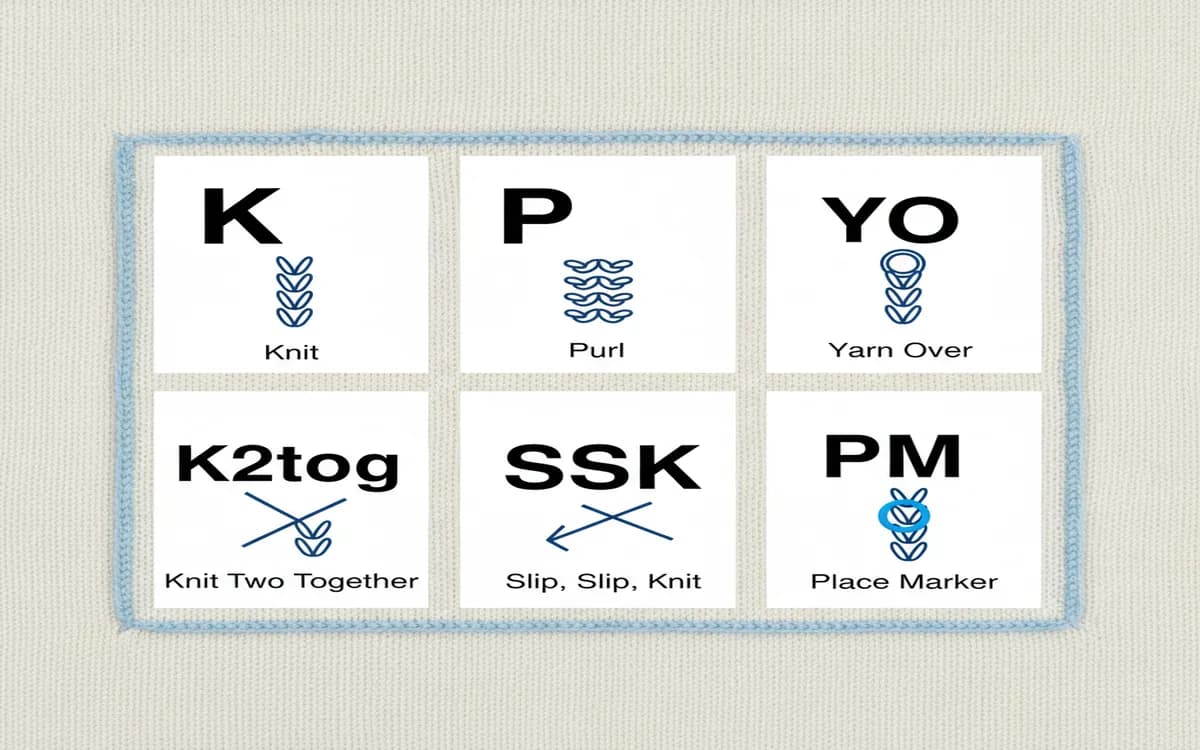
Knitting abbreviations are standardized enough that you'll recognize most of them across different patterns, though regional differences exist (British patterns sometimes use different terms than American ones). Here are the abbreviations that appear in almost every pattern you'll encounter:
K = Knit P = Purl St(s) = Stitch(es) Rep = Repeat RS = Right side (the front, public-facing side of the work) WS = Wrong side (the back, interior-facing side)
CO = Cast on BO = Bind off (also called "cast off" in British patterns)
Inc = Increase (adds a stitch) Dec = Decrease (removes a stitch)
K2tog = Knit 2 together — a right-leaning decrease that consumes 2 stitches and produces 1 SSK = Slip, slip, knit — a left-leaning decrease, the directional mirror of K2tog M1 = Make 1 — an increase worked by lifting the bar between two stitches and knitting into it M1R = Make 1 Right — a right-leaning version of M1 M1L = Make 1 Left — a left-leaning version of M1 YO = Yarn over — wraps yarn around the needle to create an extra stitch and a deliberate eyelet hole, used extensively in lace knitting
PM = Place marker (place a stitch marker on the needle) SM = Slip marker (move the marker from the left needle to the right as you pass it)
Rnd = Round (used when knitting in the round on circular or double-pointed needles) Row = Row (used when knitting flat, back and forth)
Wyif = With yarn in front Wyib = With yarn in back Sl = Slip (move a stitch from left needle to right without knitting it)
Tbl = Through the back loop (a twist that changes the stitch mount)
Many patterns include their own abbreviations list at the beginning or end. Always check it — even if you've been knitting for years, a pattern may use a non-standard abbreviation or define a special stitch unique to that design.
Reading Pattern Instructions
Parentheses ( )
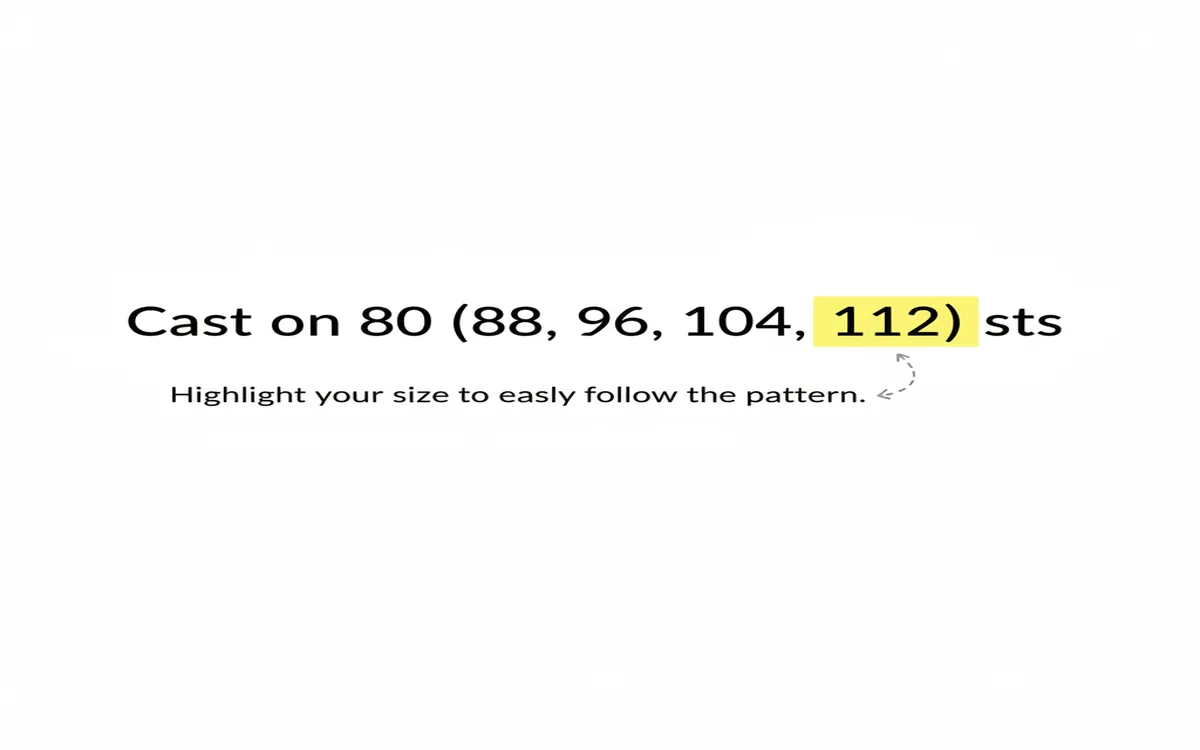
Parentheses in patterns serve two main purposes: indicating size variations and clarifying repetitions.
Sizes: "Cast on 80 (90, 100, 110) stitches" means cast on 80 for the smallest size, 90 for the second size, 100 for the third, and 110 for the largest. The sizes are typically listed smallest to largest, and the header section will tell you what each number corresponds to — for example, "Sizes: XS (S, M, L)."
Tip: Before you cast on a single stitch, go through the entire printed pattern and circle or highlight every number that corresponds to your chosen size. This one step prevents the majority of sizing errors. If you're working from a digital pattern, use the "Find and Replace" function or print it out specifically for marking up.
Parentheses are also sometimes used to clarify the stitch count after an increase or decrease row: "K2tog, knit to end (29 sts)." That number in parentheses is a checkpoint — count your stitches and confirm you have 29 before moving on.
Brackets [ ]
Brackets indicate a sequence of stitches to work as a unit and repeat.
"[K2, P2] 4 times" means work K2, P2 once, then repeat three more times for 4 total repetitions — resulting in 16 stitches worked. Brackets are often nested inside larger repeat sections, so read carefully.
Asterisks *
Asterisks mark the beginning of a repeat section that spans the entire row or until a specified stopping point.
"K1, P1, repeat from to end" means work K1, P1, then go back to where the asterisk is and repeat K1, P1 all the way to the end of the row.
You may also see double asterisks (**) used to mark a different repeat section within the same row, keeping two separate repeat zones distinct from each other.
"At the same time"
This two-word phrase is one of the most important — and most frequently misunderstood — in all of pattern writing. It means you must execute two separate sets of instructions simultaneously, in the same rows or rounds.
For example: "Continue in pattern as established while at the same time decreasing 1 stitch at the neck edge every RS row 6 times." This means your regular stitch pattern continues on every row, but on right-side rows, you also work a decrease at the neck. Missing the "at the same time" instruction is a classic beginner pitfall. Always read at least a full paragraph ahead before starting a new section so you can plan for simultaneous instructions.
Understanding Shaping Instructions
Shaping is what transforms a flat rectangle of fabric into a three-dimensional garment with curves, angles, and structure. Understanding shaping language is essential for any garment project.
"Decrease 1 stitch at each end of needle": Work a decrease near the start of the row and another near the end, on the same row. This narrows the fabric by 2 stitches total per row.
"Decrease every RS row 5 times": Work your RS row with a decrease. Work the WS row plain. Work another RS row with a decrease. Continue alternating until you've worked 5 decrease rows on the RS — a total of 10 rows worked, removing 5 stitches (or 10 if decreasing at both ends).
"Work even until piece measures 12 inches from cast-on edge": No increases or decreases — just continue the established stitch pattern until the measurement is reached. Measure flat on a hard surface, not while stretched on the needle.
Armhole shaping typically involves a rapid series of bind-offs followed by smaller, slower decreases. The bind-offs create the sharp angle at the underarm; the decreases curve the armhole upward. Both happen over the same section of knitting and are described as separate series of instructions that must be read together.
Reading Charts
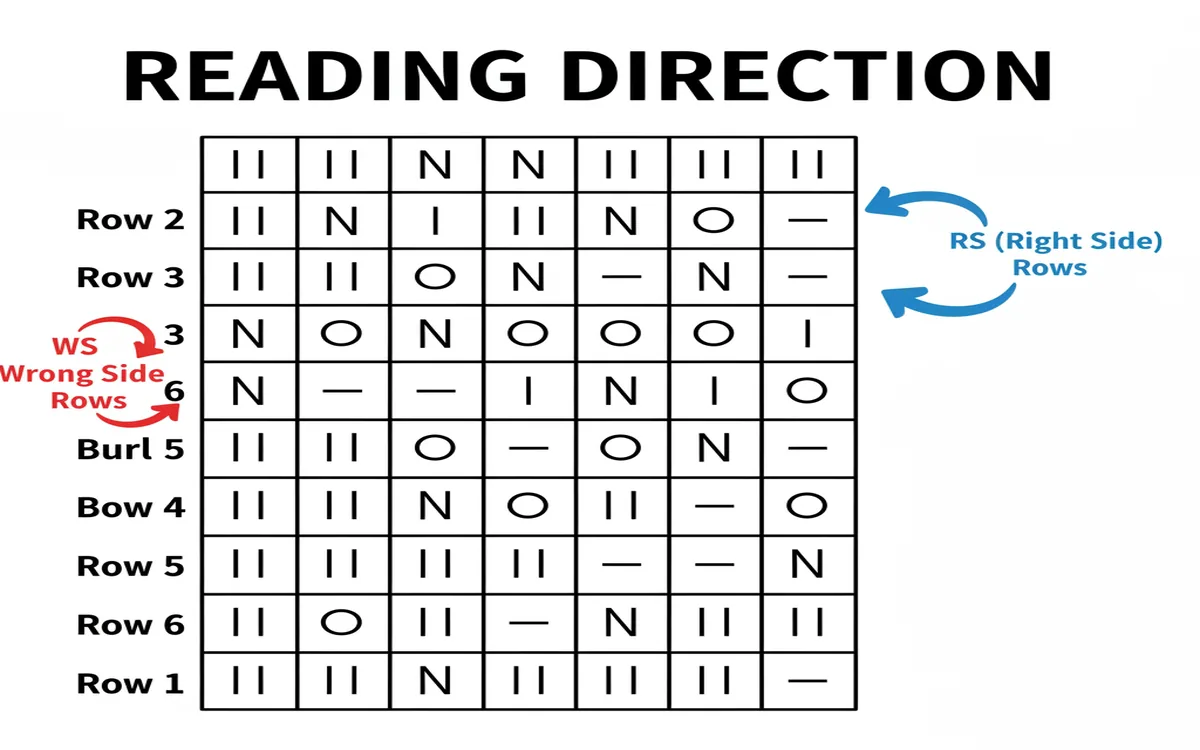
Charts are visual representations of stitch patterns. Each square in the grid represents one stitch; each row of squares represents one row or round of knitting.
Reading direction:
- RS rows: Read right to left (the direction your work travels)
- WS rows: Read left to right
- In the round: Always read right to left, because you're always on the RS
Row numbers are usually printed along the sides of the chart — odd-numbered rows (RS) on the right side, even-numbered rows (WS) on the left. Start from the bottom of the chart and work upward.
Symbols: Every pattern defines its own chart symbols in a legend called the chart key. A blank white square almost universally means "knit on RS, purl on WS." A dot or dash typically means "purl on RS, knit on WS." Beyond those two, symbols vary by designer and must be confirmed in the key.
Charts feel intimidating at first, but most knitters who work with them regularly report they become easier than written instructions — especially for complex stitch patterns like cables or lace, where seeing the visual layout mirrors what you're actually knitting. Place a ruler or a piece of paper above your current row to keep your place.
The Importance of Gauge
Gauge is listed as something like: "20 stitches and 28 rows = 4 inches in stockinette stitch on US 7 (4.5mm) needles."
This means the designer worked at a density of 20 stitches across 4 inches. If you knit at the same tension with the same yarn and needles, your finished measurements will match the pattern's.
If your gauge doesn't match:
- More stitches per 4 inches = Your fabric is tighter than intended; your finished piece will be smaller than stated
- Fewer stitches per 4 inches = Your fabric is looser than intended; your finished piece will be larger than stated
A gauge difference of just 1 stitch per 4 inches may sound negligible. But on a sweater chest with 200 stitches, that 1-stitch difference becomes 2.5 inches of lost or gained circumference. That's the difference between a sweater that fits and one that doesn't.
Always knit a gauge swatch before starting any garment. Cast on at least 30 stitches and work at least 4 inches. Wash and block the swatch the same way you'll wash the finished garment — yarn relaxes and changes dimensions after washing. Measure the swatch flat, count stitches over 4 inches in the center (not near the edges), and adjust needle size up or down until your gauge matches. If matching a fixed gauge feels like a fight, our knitting pattern generator works the other way around: it builds the pattern around the gauge you actually knit.
Working Through a Pattern Section
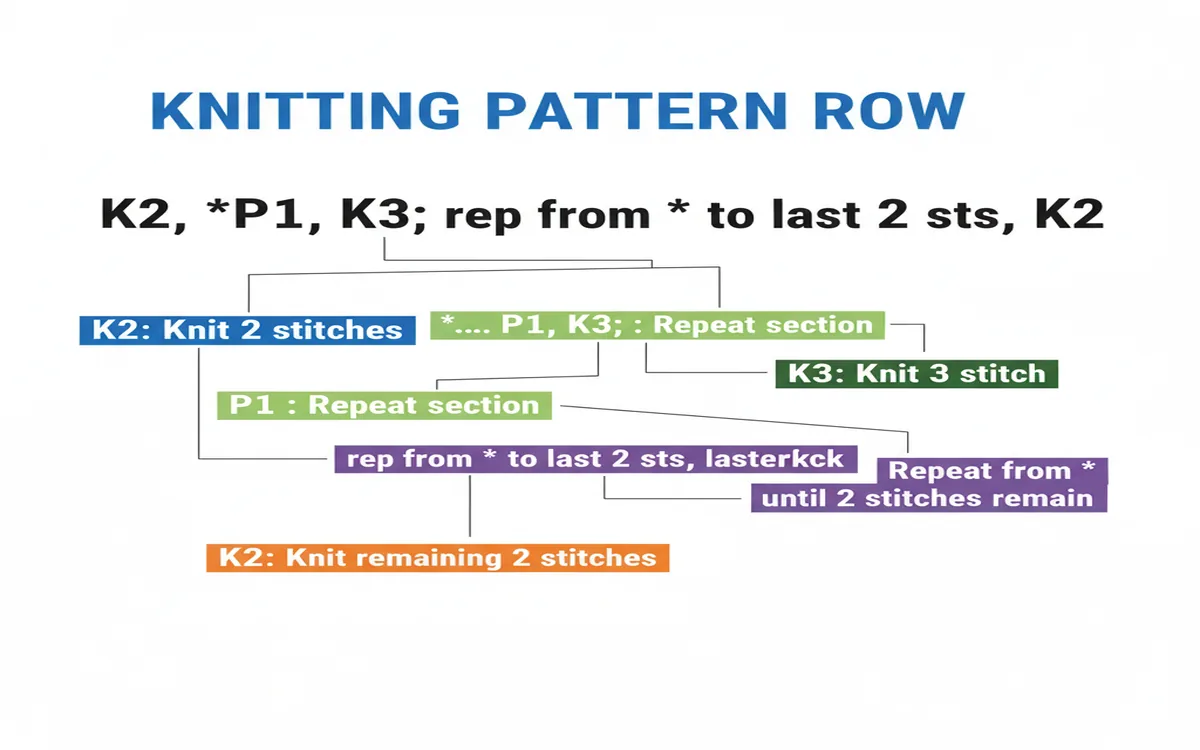
Let's decode a real example to practice reading pattern language:
"Row 1 (RS): K3, P2, K2, rep from to last 5 sts, P2, K3. Row 2 (WS): P3, K2, P2, rep from to last 5 sts, K2, P3."
Breaking Row 1 down step by step: 1. Knit 3 stitches (left border) 2. Purl 2, knit 2 (first repeat unit) 3. Continue purling 2 and knitting 2 until exactly 5 stitches remain on the left needle 4. Purl 2, then knit the final 3 stitches (right border)
Breaking Row 2 down: 1. Purl 3 stitches (left border, mirrored from Row 1) 2. Knit 2, purl 2 (repeat unit, mirrored for WS) 3. Continue until 5 stitches remain 4. Knit 2, purl the final 3 stitches (right border)
The result is a ribbed stitch pattern (K2, P2 rib) flanked by a 3-stitch border. The borders keep the edges neat and prevent the ribbing from curling. Notice that Row 2 mirrors Row 1 — on wrong-side rows, you work the opposite stitch of what you see facing you, so knit stitches become purl and vice versa.
If the math doesn't work out evenly — you reach your last 5 stitches in the middle of a K2 repeat, for example — recount from the beginning. Misreads almost always reveal themselves through stitch count mismatches.
When You're Confused
Pattern confusion happens to every knitter, regardless of experience level. Here's how to work through it systematically:
Re-read slowly: Pattern language is precise. Every word, every comma, and every number is intentional. Read the instruction out loud if it helps.
Count your stitches: After every increase row, decrease row, or complex repeat section, count. If the numbers don't add up, you'll catch the problem early rather than 20 rows later.
Look for errata: Many published patterns contain errors. Designers and publishers post corrections (called errata) on their websites, on Ravelry, or in Ravelry project notes. Always search for errata before assuming you've misunderstood the pattern.
Check Ravelry project notes: Other knitters document confusing sections and how they interpreted and solved them. A quick search of the pattern's Ravelry page often turns up exactly the clarification you need.
Read ahead: Understanding what comes next can illuminate what you're supposed to be doing right now. Context matters enormously in pattern reading.
Contact the designer: Many independent designers respond to knitter questions directly through Ravelry or their own websites. A polite, specific question ("In Row 12 of the sleeve shaping, does the decrease happen before or after the cable cross?") almost always gets a helpful response.
Tips for Pattern Success
Print it out: A physical copy is much easier to mark up, highlight, and track than scrolling through a screen while needles are in your hands.
Read the whole pattern first: Before casting on a single stitch, read every section from beginning to end. You'll understand how the pieces connect, anticipate the "at the same time" moments, and avoid unpleasant surprises.
Use a row counter: Whether a physical click counter, a dedicated app, or tally marks on paper, tracking your row number prevents the most common knitting mistake — losing your place.
Take notes: Write down modifications, yarn substitutions, and needle size changes in the margin or in a knitting notebook. If you knit the same pattern again or recommend it to a friend, you'll have a record of what worked.
Trust the pattern (mostly): If something seems wrong, double-check the errata and re-read carefully before assuming the designer made an error. That said, errors do exist — trust your stitch count over the written instruction when they conflict.
Block your swatch and your finished piece: Blocking (wetting, reshaping, and drying your knitting) is what makes everything look professional. Many stitch patterns don't open up and settle until after blocking. Gauge also often changes after blocking, which is why swatching post-wash matters so much.
When Standard Patterns Don't Work
Standard patterns are written for a range of preset sizes that may not reflect your actual body measurements. A size Medium might fit your chest perfectly but have sleeves that are 3 inches too short. A shawl pattern might be designed for a specific yardage that your yarn doesn't match.
In these situations, you have two options: modify an existing pattern (which requires comfort with basic math and knitting geometry) or start from a pattern written specifically for your measurements.
La Maille generates custom knitting patterns based on your specific measurements and gauge. The resulting instructions follow all the same conventions described in this guide — abbreviations, row-by-row directions, shaping language — but every number is calculated for your body and your tension. Reading a custom pattern uses exactly the same skills as reading any other pattern, but the fit is built in from the start.
Frequently Asked Questions
What do knitting abbreviations mean? The most common ones: K = knit, P = purl, St(s) = stitch(es), Rep = repeat, RS = right side, WS = wrong side, CO = cast on, BO = bind off, K2tog = knit 2 together (right-leaning decrease), SSK = slip slip knit (left-leaning decrease), M1 = make 1 (an increase), YO = yarn over (creates an eyelet). Always check the specific pattern's abbreviations list, as some designers use non-standard terms or define special stitches unique to their design.
What do parentheses mean in knitting patterns? Parentheses most commonly indicate size variations. "CO 80 (90, 100, 110) stitches" means cast on 80 for the smallest size, 90 for the next, and so on. The pattern header will tell you which number corresponds to which size. Before starting, go through the whole pattern and circle every number for your chosen size. Parentheses can also indicate a stitch count check: "(29 sts)" after a shaping row tells you how many stitches you should have at that point.
What does "repeat from to end" mean? Work the sequence of stitches that follows the asterisk, then go back to the asterisk and repeat that same sequence across the entire row until you reach the end. For example, "K2, P2, repeat from * to end" means you keep working K2, P2 all the way to the last stitch of the row. If the total stitch count isn't a multiple of 4, the pattern will specify what to do with the remaining stitches.
How do I read a knitting chart? Start at the bottom right corner of the chart. RS rows (usually odd-numbered) are read right to left. WS rows (usually even-numbered) are read left to right. Each square represents one stitch. Symbols are defined in the chart key provided with the pattern. A blank square almost always means knit on RS and purl on WS. Use a ruler or sticky note to mark your current row and prevent reading the wrong line.
What's the most important number in a pattern? Gauge — specifically, the stitch gauge (stitches per 4 inches). If your stitches per inch doesn't match the pattern's gauge, your finished measurements will be off regardless of how perfectly you follow every other instruction. Even a difference of half a stitch per inch can mean a full inch of size difference across a garment panel.
How do I choose which size to knit? Compare the pattern's finished measurements to a garment you already wear and love the fit of, not to your body measurements alone. Most knitting patterns for garments include "ease" — extra fabric beyond your actual body measurement. A sweater with 4 inches of positive ease will hang looser and more relaxed; one with 0 inches of ease will be body-skimming. Choose the size whose finished chest measurement is closest to your preferred wearing ease, then check the length and sleeve measurements separately.
What does "work even" mean in a pattern? "Work even" means continue working in the established stitch pattern — whatever you've been doing — without adding any increases or decreases. It's an instruction to keep knitting until you reach a specific measurement or row count. Think of it as "keep going, no changes."
Ready to try a pattern? Whether you're following a published design or generating a custom one, understanding pattern language opens up the entire world of garment knitting. Start with a simple project, read the whole pattern before casting on, and trust the process — every experienced knitter was once a beginner decoding their very first row instruction.