Top-down sweater knitting begins at the neckline and works downward toward the hem, allowing you to try the garment on at any point during construction. Bottom-up sweater knitting starts at the hem and works upward toward the shoulders, following a more traditional construction sequence. Both methods can produce identical finished sweaters — the difference lies entirely in the direction of knitting, the order of operations, and how fit is managed along the way. Top-down construction was popularized in the English-speaking world largely through Elizabeth Zimmermann's work in the 1960s and 1970s, and today both methods are fully supported by modern tools and AI pattern generators like La Maille. Here is everything you need to know to choose the right direction for your next sweater project.
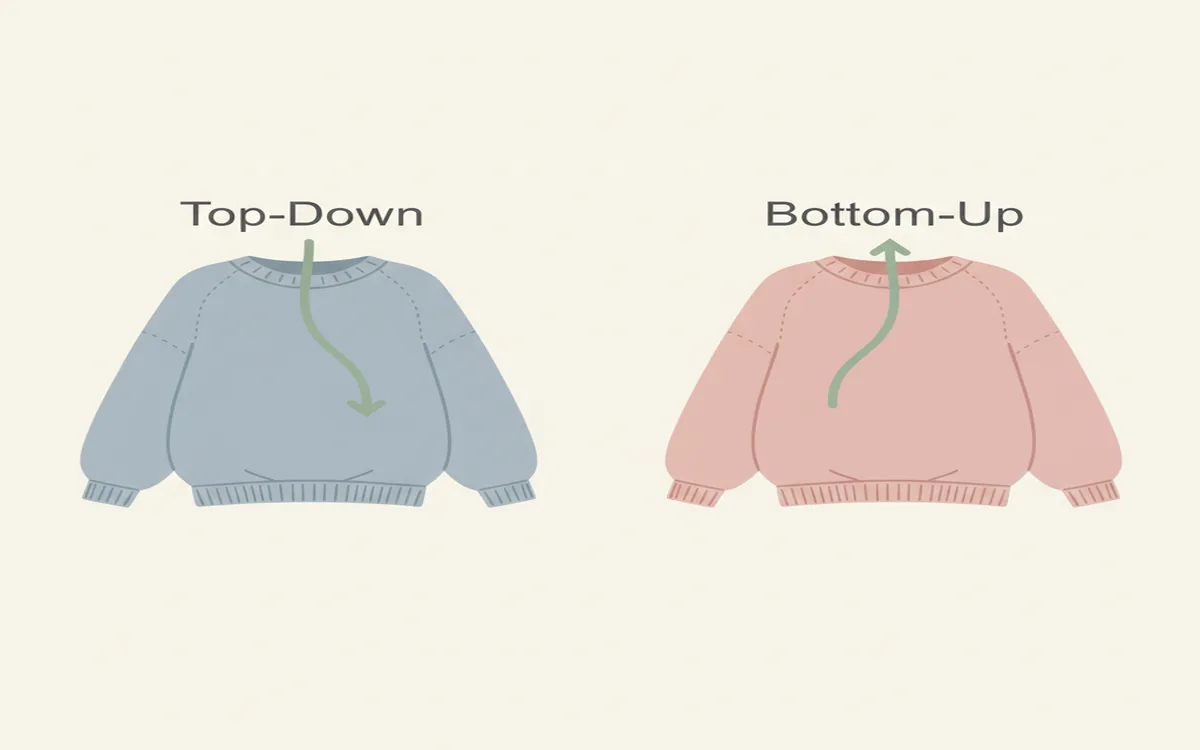
Top-Down Construction
In top-down construction, you cast on at the neckline and work your way down to the hem. The yoke is shaped first through a series of increases, and the body and sleeves are separated at the underarm and finished individually. This method is almost always worked in the round, making it one of the most truly seamless approaches to sweater construction available.
Top-down sweaters are commonly built with a raglan yoke, a circular yoke, or a hybrid set-in sleeve construction — each of which handles the increase math differently but follows the same fundamental top-to-bottom logic. A raglan yoke, for example, typically adds 8 stitches every other round across 4 increase lines, while a circular yoke distributes increases more evenly across several graduated sections.
How It Works
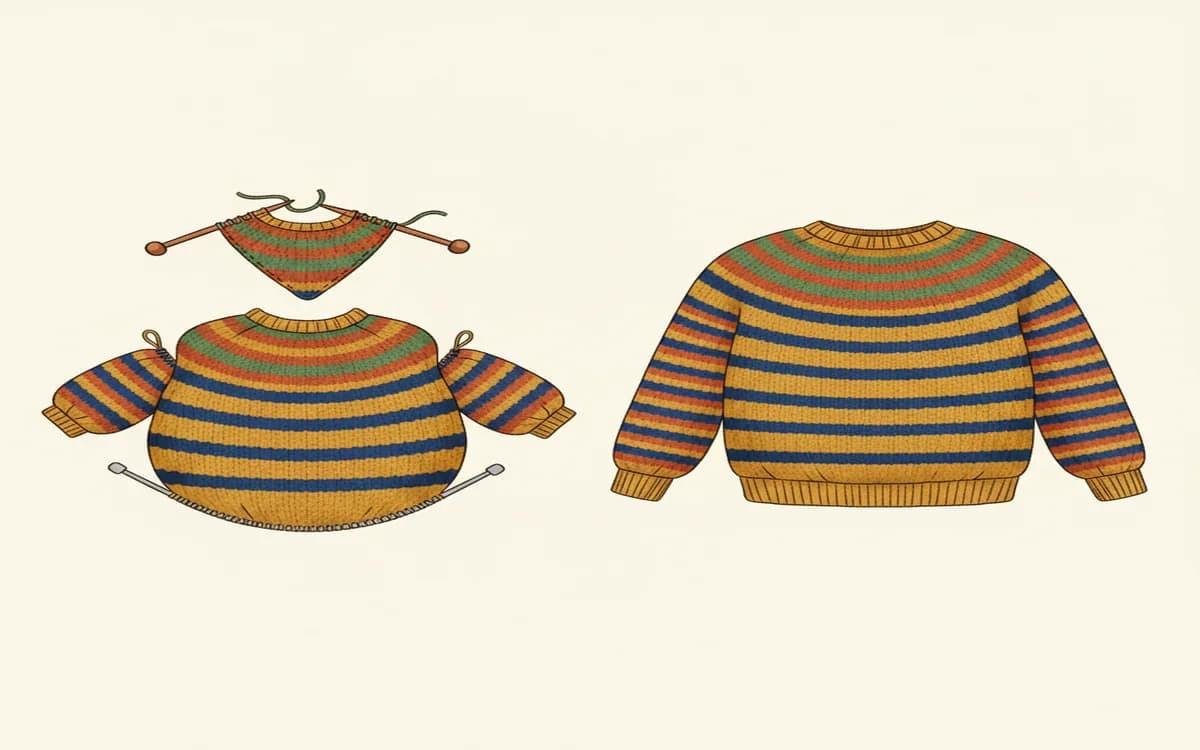
1. Cast on stitches for the neckline — typically between 80 and 120 stitches for an adult sweater in worsted weight 2. Work the yoke, increasing regularly to create shoulder and upper body width 3. At the underarm, divide stitches: body stitches stay on the needle, sleeve stitches go on holders or waste yarn 4. Continue knitting the body down to the hem, adjusting length as needed 5. Pick up sleeve stitches and knit sleeves down to the cuffs, decreasing along the way to taper the sleeve
The underarm is typically bridged by casting on a small number of stitches — usually 4 to 10, depending on ease — to create a smooth join between body and sleeve sections.
Advantages of Top-Down
Try-on as you go: This is the defining advantage of top-down sweater knitting. You can slip the work over your head at any point to check fit across the shoulders, through the chest, and at the waist. This real-time fit feedback is invaluable, especially for knitters who fall between sizes or have fit challenges like a broad back, a full bust, or sloped shoulders.
Easy length adjustments: Not sure if the body is long enough? Just keep knitting. There is no commitment to length until you cast off, which means you can hold the sweater against your body and decide in the moment. Sleeve length is equally flexible for the same reason.
No seaming (usually): Most top-down patterns are seamless, knit entirely in the round with zero finishing seams. If you dislike mattress stitch or find seaming fiddly and time-consuming, top-down construction removes that step entirely.
Easier to modify on the fly: Because you can try on as you go and because each section flows naturally into the next, it is simpler to make spontaneous adjustments — widening the body, adding waist shaping, or lengthening the torso — without ripping back large sections.
Great for managing uncertain yarn quantities: Not sure if you have enough yarn? In top-down construction, the last thing you knit is the lower body hem and the sleeve cuffs. These are the easiest places to shorten if you start running low. You can even switch to a contrasting color for the final few centimeters rather than ripping back.
Continuous feedback on gauge: Knitting a large piece from the top down lets you spot gauge drift early. If your tension changes over the first 10 centimeters, you can adjust before the error compounds across an entire body piece.
Disadvantages of Top-Down
Yarn weight distribution: As you progress toward the hem, the full weight of the sweater hangs from your needles. For heavier yarns or large sizes, this can make the knitting physically tiring and may distort the fabric near the active stitches.
Difficult to fix the neckline: The neckline is your cast-on edge. If the neck opening is too tight to pull over your head, or too wide and droopy, correcting it after the fact is awkward. Adding a neckband can compensate somewhat, but the underlying cast-on edge is fixed.
Some techniques are less natural: Picked-up neckbands, certain colorwork motifs, and stitch patterns with a strong directional flow can feel counterintuitive when worked top-down. Cables, for instance, look identical either way, but lace motifs with directional leaves or feathers may appear upside-down when knitted from the top.
Divergence from classic patterns: The majority of vintage and traditional patterns — including most Fair Isle, Aran, and Scandinavian sweater patterns — were designed bottom-up. Following these patterns in their original direction is simpler than converting them.
Bottom-Up Construction
In bottom-up construction, you start at the hem and work up to the shoulders. Pieces are often worked separately and seamed together at the end, though seamless bottom-up constructions also exist and are widely used. This is the older and historically dominant approach to sweater knitting.
How It Works (Pieced)
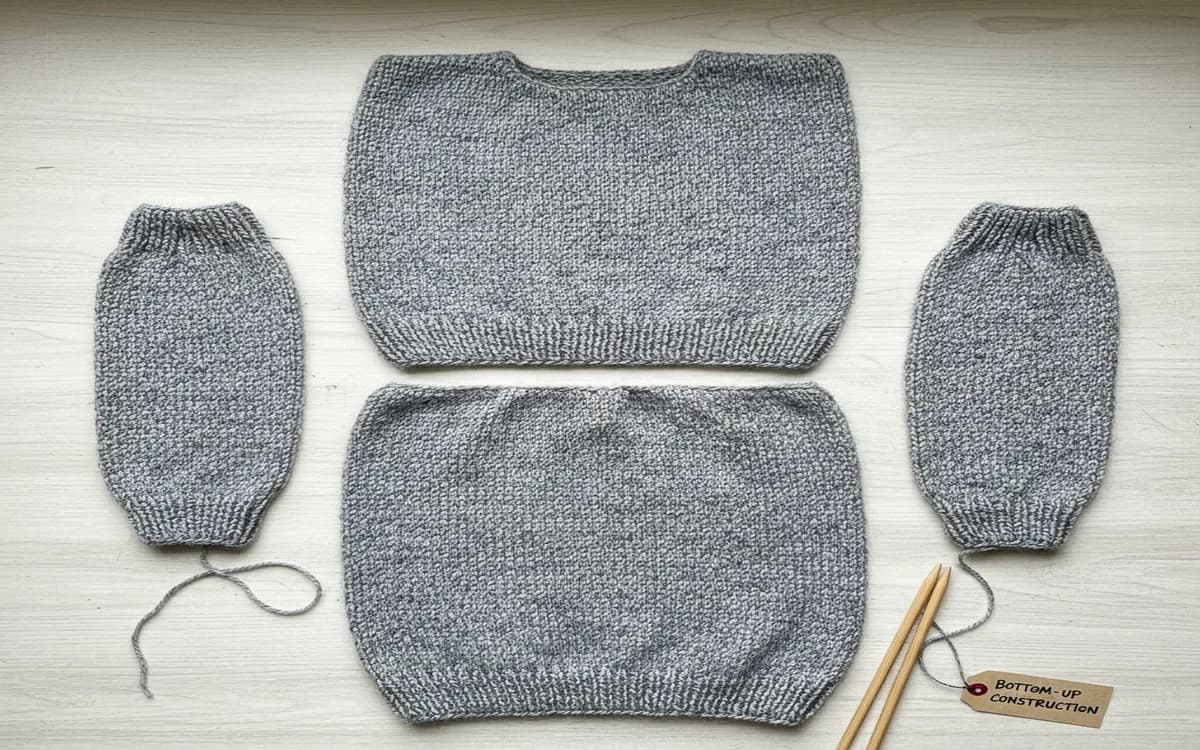
1. Knit the back from hem to shoulders, working flat 2. Knit the front from hem to shoulders, including any neckline shaping 3. Knit two sleeves from cuff to upper arm, increasing along the sleeve seam 4. Seam all pieces together using mattress stitch or three-needle bind-off 5. Pick up stitches around the neck opening and knit the neckband
Pieced construction produces 4 to 5 separate pieces before assembly. A typical adult cardigan in pieced construction might require joining seams totaling 2 to 3 metres in length.
How It Works (Seamless)
1. Knit the body in the round from hem to underarm 2. Knit sleeves in the round from cuff to underarm 3. Join body and sleeves at the underarm onto a single circular needle 4. Work the yoke, decreasing toward the neckline 5. Bind off or graft at the neckline and add a neckband
Seamless bottom-up construction is particularly popular for colorwork sweaters like the traditional Icelandic lopapeysa, where the circular yoke is the decorative centerpiece and is most naturally worked in the round from the bottom up.
Advantages of Bottom-Up
Traditional construction: The majority of classic knitting patterns, especially those published before the 1980s, use bottom-up construction. If you enjoy working from vintage sources or traditional regional patterns, bottom-up will feel natural and require no conversion.
Neckline flexibility: Because the neckline is the last thing you knit, you can adjust the neck opening based on how the sweater has actually turned out. You can make the neck wider or narrower than the original pattern specifies, add a deeper V, or switch from a crew neck to a turtleneck.
Easier stitch patterns: Stitch patterns with a directional element — feather-and-fan lace, certain leaf motifs, pictorial colorwork — work most naturally bottom-up because the pattern reads in the correct orientation as you knit.
Lighter pieces in hand: When knitting separate pieces flat, you are always handling a small, manageable section of fabric. There is no moment where the full weight of a near-finished sweater drags on your wrists and needles.
Seams add structure: For tailored styles, structured blazer-style cardigans, or any sweater where you want the shoulder line to hold its shape over years of wear, seams provide genuine structural benefit. A well-executed shoulder seam can extend the life of a garment significantly.
Disadvantages of Bottom-Up
Can't try on until seamed: You won't know how a pieced bottom-up sweater truly fits until all pieces are joined and the neckband is finished. This can produce disappointing surprises after 40 or more hours of work.
Length commitment: Body and sleeve length must be decided before you reach the underarm shaping. Changing your mind later means ripping back potentially hundreds of rows.
Seaming required (usually): Even seamless bottom-up constructions typically involve a small amount of underarm seaming or grafting. Pieced construction demands substantial finishing work that some knitters find tedious or difficult to execute neatly.
Yarn management risk: If you run out of yarn while working a flat piece, you may be stranded in the middle of a back panel with no clean stopping point. Running out during a top-down hem, by contrast, simply means a shorter sweater.
How to Choose
Choose Top-Down When:
- You have had fit problems in the past and want to try on as you go
- You are unsure about your ideal body length or sleeve length
- You strongly dislike seaming
- You are working with a limited or uncertain yarn quantity
- You are new to sweater construction and want the reassurance of regular fit checks
- You are knitting a raglan or circular yoke, which are most naturally worked top-down
Choose Bottom-Up When:
- You are following a pattern written bottom-up and prefer not to convert it
- You want seams to provide structure and longevity
- You prefer handling smaller, lighter pieces rather than a growing sweater on your needles
- You are working a directional stitch pattern or traditional colorwork
- You are confident in your measurements and do not need mid-project try-ons
- You enjoy the finishing process and find seaming satisfying
Either Method Works When:
- You are confident in your measurements and gauge
- The pattern is clearly written for the chosen construction
- You are working a simple stockinette or ribbed design with no strong directional elements
- You are willing to commit to the work each method requires
Converting Between Methods
It is possible to convert a top-down pattern to bottom-up and vice versa, but the process is not trivial and should not be attempted lightly on a complex pattern.
Key challenges include:
- All shaping reverses — increases become decreases and vice versa
- The order of operations changes completely
- Techniques like short-row bust darts or German short-row shoulders work differently in each direction
- Stitch patterns may need to be vertically mirrored to read correctly
- Cast-on and bind-off edges have different visual textures, which can affect the hem and neckline appearance
Unless you are an experienced pattern writer or have significant sweater construction experience, it is almost always more efficient to find a pattern already written in your preferred direction.
What About AI Pattern Generation?
When using tools like La Maille to generate custom patterns from photos, the AI determines construction method based on what is most appropriate for the specific design. A raglan pullover, for example, will likely be generated top-down, while a traditional colorwork yoke sweater might be generated bottom-up. You can specify your construction preference if the tool supports it, or generate the pattern and adapt the construction direction if you have the technical skills to do so.
The meaningful advantage of AI-generated custom patterns is that the stitch counts and shaping are already calculated for your exact measurements — regardless of construction direction. This gives you the practical fit benefits traditionally associated with top-down knitting, embedded directly into a pattern that may work in either direction.
Frequently Asked Questions
What's the difference between top-down and bottom-up sweaters? Top-down sweater knitting starts at the neckline and works down to the hem, allowing try-ons throughout the process. Bottom-up starts at the hem and works up to the shoulders, following traditional construction logic. Both methods can produce beautiful, well-fitting sweaters — the choice affects construction sequence, fit checking, finishing work, and how well certain stitch patterns translate.
Which construction method is better for beginners? Top-down is generally recommended for beginners because you can try the sweater on as you go, adjust length at any point, and most top-down patterns are fully seamless, eliminating the need to learn mattress stitch or shoulder seaming. That said, bottom-up pieced construction teaches foundational skills — seaming, blocking flat pieces, and assembling a garment — that are valuable if you want to knit a wide range of patterns.
Can I try on a bottom-up sweater while knitting? Not effectively. In pieced construction, the front, back, and sleeves are all separate until the final assembly, so there is nothing cohesive to try on. In seamless bottom-up construction, you can hold the body section against yourself once it is long enough, but fit across the shoulder and sleeve cannot be assessed until the yoke is joined and worked. Estimating fit from measurements and a swatch remains the most reliable method for bottom-up knitters.
Why would someone choose bottom-up over top-down? Several strong reasons: access to a wider range of traditional and vintage patterns, the structural benefit of seams for tailored styles, the comfort of working with lighter individual pieces rather than a growing sweater on your needles, better behavior of directional stitch patterns, and the satisfying craft of assembling a finished garment from separate pieces.
Can I convert a top-down pattern to bottom-up? Yes, but it requires reversing all shaping, reordering construction steps, and potentially mirroring stitch patterns. For simple patterns this is manageable; for complex shaped garments it can be as much work as writing a new pattern from scratch. When possible, seek out a pattern already written in your preferred direction.
Does construction method affect the finished appearance of the sweater? In most cases, no. A well-knitted sweater looks the same regardless of which direction it was constructed. The main visual difference is the texture of the cast-on versus bound-off edge at the hem and cuffs — cast-on edges tend to be slightly tighter and more defined, while bound-off edges are softer. For most designs this difference is negligible, but it is worth considering if a very clean, firm hem edge is important to your design.
How does gauge affect top-down versus bottom-up construction? Gauge is equally critical in both methods, but the consequences of gauge error differ. In top-down knitting, gauge drift (where your tension changes as the piece grows) can cause the lower body to be wider or narrower than expected — but because you can try on as you go, you may catch this earlier. In bottom-up pieced construction, a gauge error discovered after completing all four pieces means either reknitting or accepting a misfit. Swatching thoroughly before starting either method remains non-negotiable.
Ready to knit your next sweater? Try La Maille — upload a photo of any style and get a custom pattern designed for your measurements.