Knitting gauge is the number of stitches and rows per inch (or per 4 inches / 10 centimeters) you achieve with a specific yarn, needle size, and stitch pattern — and it determines every single measurement in your finished garment. A difference of just half a stitch per inch can result in a sweater that is 2 to 4 inches off your target size. That is why every reliable pattern tool, including La Maille, requires your exact gauge before generating stitch counts. Whether you are a seasoned knitter or tackling your first sweater, understanding how to measure, match, and troubleshoot gauge is the single most impactful skill you can develop. This guide covers everything you need to know.
What Is Gauge?
Gauge (called tension in UK and Australian patterns) is the number of stitches and rows you get per unit of measurement — typically per 4 inches or 10 centimeters. It is always specific to a combination of three variables: your yarn, your needle size, and your stitch pattern. Change any one of those, and your gauge changes too.
A pattern might say: "20 stitches and 28 rows = 4 inches in stockinette stitch on 4.5mm needles."
This tells you that the designer, working with their specific yarn and needle combination, achieved exactly that fabric density over a 4-inch square. If you want your finished garment to match the pattern's intended measurements — the bust circumference, the sleeve length, the shoulder width — you need to replicate that same fabric density. Gauge is not a suggestion. It is the mathematical foundation the entire pattern is built on.
In practical terms: if a pattern gives a gauge of 20 stitches per 4 inches, that equals 5 stitches per inch. Every stitch count in that pattern — the number of stitches to cast on, to increase, to bind off — was calculated using that number. Use a different gauge and every single calculation is off.
Why Gauge Matters
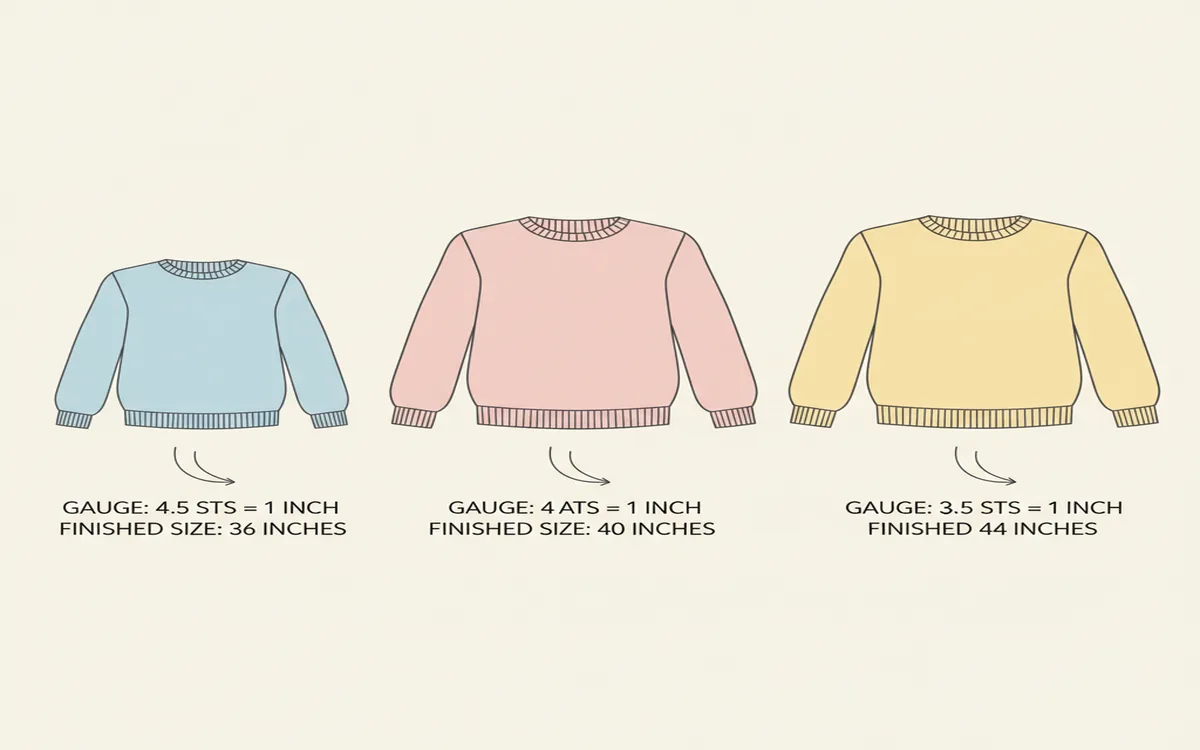
Here is a simple, concrete example that shows exactly why gauge is critical:
Imagine you are knitting a sweater with a 40-inch bust circumference. The pattern assumes 5 stitches per inch, so it instructs you to cast on 200 stitches for the body worked in the round.
But your knitting runs tight — you get 5.5 stitches per inch instead of 5. Those same 200 stitches now span only 36.4 inches around. That is nearly 4 inches too small. You have just knitted yourself out of a wearable garment.
Or perhaps you knit loosely at 4.5 stitches per inch. Your 200 stitches become a 44-inch sweater — generous and oversized, perhaps even unwearable if the pattern was intended to be fitted.
A half-stitch difference per inch, applied across 200 stitches, shifts your garment by 4 full inches. That is typically 1 to 2 full sizes in most sizing charts.
Row gauge carries its own consequences. If your row gauge is off, the armhole depth, the yoke length, and the sleeve cap may all be shorter or longer than intended — sometimes by several inches. While row gauge is often more forgiving than stitch gauge (since lengths can be adjusted as you knit), it still matters enormously in shaped sections like raglan yokes and set-in sleeves.
How to Make a Gauge Swatch
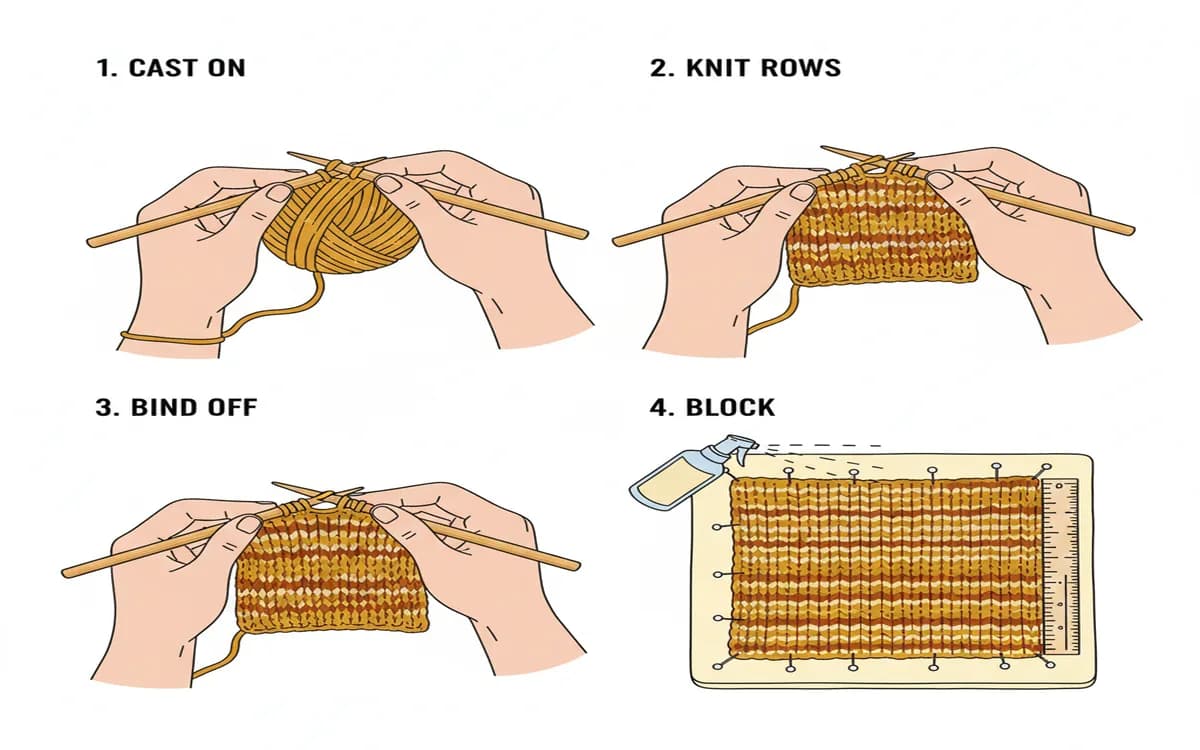
A gauge swatch is a sample piece of knitting — typically at least 6 inches square — used to measure your personal stitch and row density before committing to a full project. Here is how to do it correctly:
Step 1: Cast On More Than You Need
If the pattern gauge is 20 stitches over 4 inches, cast on at least 30 to 36 stitches. You need a generous border of fabric surrounding your measurement zone. Edge stitches behave differently from interior stitches — they curl, pull, and distort — and if you measure into those edges, your count will be inaccurate. Give yourself at least 3 to 4 stitches of buffer on each side.
Step 2: Use the Right Yarn, Needles, and Stitch Pattern
Match the pattern as precisely as possible:
- The same yarn, or a substitute of the same weight and fiber content
- The exact needle size recommended in the pattern
- The exact stitch pattern in which the gauge is given (stockinette, ribbing, cables, seed stitch — these all produce different gauges)
If the pattern gives gauge in colorwork, swatch in colorwork. If it gives gauge in ribbing, swatch in ribbing. Do not assume that your stockinette gauge translates.
Step 3: Knit at Least 5 to 6 Inches in Length
You need enough rows to measure 4 inches vertically with border rows above and below. Most knitters find that a swatch of 5 to 6 inches gives a reliable and measurable center zone. Skimping on length here is one of the most common swatching mistakes.
Step 4: Bind Off and Finish
Do not measure live stitches on the needle. Stitches stretch horizontally when held on a needle, inflating your stitch count and giving you a falsely loose gauge reading. Bind off loosely (or use a provisional cast-off if you plan to reuse the yarn), then weave in the ends neatly so they do not distort the fabric.
Step 5: Wash and Block
This is the step most knitters skip — and it is the most critical one. Your finished sweater will be washed and blocked, so your swatch must undergo the same treatment before you measure it. Many yarns change dramatically after washing: wool can bloom and soften, cotton can grow by 10 to 15 percent, acrylics may relax or stiffen. Block the swatch exactly as you plan to block the finished garment — wet blocking, steam blocking, or spray blocking — whichever is appropriate for the fiber.
Step 6: Let It Rest and Dry Completely
Give your blocked swatch at least several hours, and ideally overnight, to fully dry and relax. Measuring a damp or partially dry swatch will give you inaccurate results, since wet fibers are still shifting and settling.
How to Measure Gauge
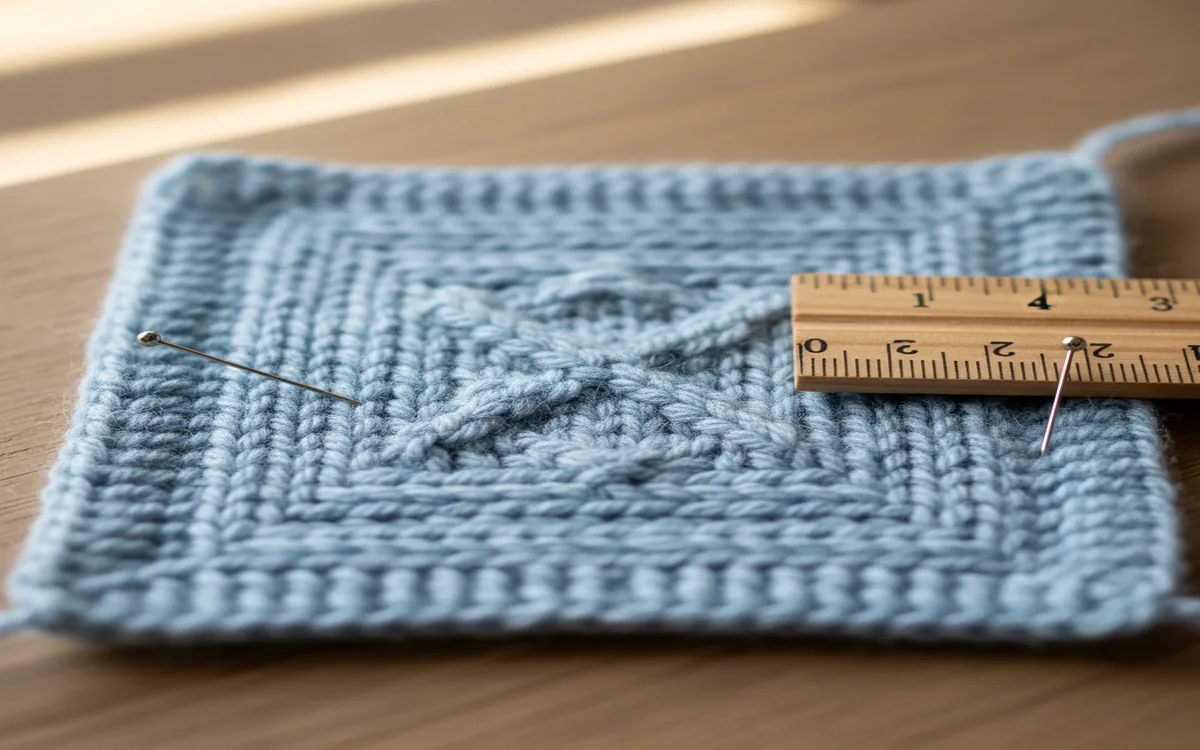
Once your swatch is dry and blocked, it is time to measure. Use a rigid ruler or a dedicated gauge ruler rather than a flexible tape measure, which can stretch slightly and introduce error.
For stitch gauge: Lay the swatch flat on a table. Place your ruler horizontally across the center of the swatch — away from the cast-on edge, the bind-off edge, and the side edges. Count how many stitches fit in exactly 4 inches. Include half-stitches in your count: if you see 20.5 stitches, record 20.5. That half-stitch matters more than most knitters realize.
For row gauge: Rotate the ruler vertically and count the number of rows over 4 inches in the center of the swatch.
Some knitters prefer to measure over 2 inches and double the result, which can make counting individual stitches and rows easier. Either method is valid as long as you are consistent and precise.
Tools That Help
- Gauge rulers: Feature a 2-inch or 4-inch rectangular window that frames your counting area cleanly
- Stitch markers: Place two markers exactly 4 inches apart to frame your count
- Magnification: A magnifying glass helps when counting fine-weight yarns or textured stitches
- Phone apps: Several knitting apps allow you to photograph your swatch and analyze stitch counts digitally
What If Your Gauge Doesn't Match?
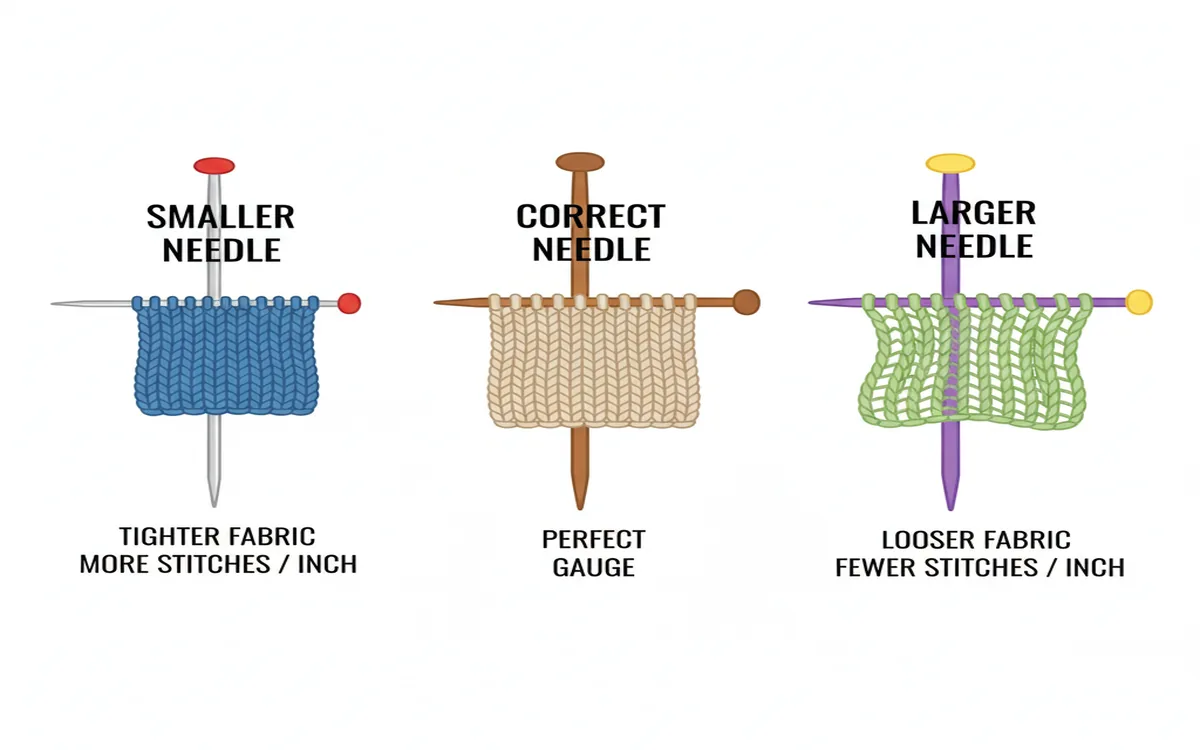
Gauge mismatch is not a sign of failure — it is completely normal, and it is exactly what swatching is designed to catch. Here is how to respond:
Too many stitches per 4 inches (tight gauge): Your fabric is denser than intended. Switch to larger needles — go up by one needle size (for example, from 4.5mm to 5mm) and knit a new swatch. Repeat until your gauge matches.
Too few stitches per 4 inches (loose gauge): Your fabric is more open than intended. Switch to smaller needles — go down by one size — and swatch again.
It sometimes takes two or three swatches to land on the right needle size. This is normal. Each swatch brings you closer. Needle material also affects gauge: metal needles tend to produce slightly looser knitting than wooden or bamboo needles, since yarn slides more freely on slick surfaces.
When Exact Gauge Matters Most
Stitch gauge is almost always more important than row gauge, for this reason:
- Stitch gauge controls width — bust circumference, sleeve width, neckline opening
- Row gauge controls length — body length, sleeve length, yoke depth
Width is structurally fixed by your stitch count. Length, in most patterns, can be adjusted by knitting more or fewer rows before a shaping point. If you can match stitch gauge but your row gauge is slightly off, you can usually proceed and adjust the lengths as you knit — trying the garment on as you go or following measurement-based instructions rather than row counts.
If both gauges are off, prioritize stitch gauge first, then assess whether row gauge will require length modifications.
Gauge in Pattern Generation
When you use a tool like La Maille to generate a custom pattern, your gauge becomes the engine behind every number in the pattern. The system uses your specific stitch gauge and row gauge to calculate precise cast-on counts, increase and decrease rates, yoke depths, and bind-off instructions — all calibrated to your actual measurements rather than a standardized size chart.
This is fundamentally different from following a published pattern, which is written to a fixed gauge and requires you to match it. With custom pattern generation, the pattern bends to fit your gauge and your body. That only works if the gauge you enter is accurate, which makes a properly measured swatch even more essential.
Common Gauge Mistakes
Measuring on the needles: Live stitches expand horizontally on the needle, making your gauge appear looser than it is. Always bind off before measuring.
Skipping the wash: Yarn changes after washing. A pre-wash gauge can differ from a post-wash gauge by 5 to 15 percent, depending on the fiber. Always wash your swatch.
Measuring at the edges: The first and last few stitches of every row are structurally distorted. Measure only in the center of your swatch.
Using a flexible tape measure: Tape measures can stretch slightly, especially older ones. Use a rigid ruler for accuracy.
Assuming your gauge is consistent across projects: Your gauge can shift depending on the yarn fiber, the needle material, how relaxed or tense you are, even the time of day. Swatch for every new project, even if you have used the same needle size before.
Swatching in a different stitch pattern: If the gauge is given in stockinette, do not swatch in garter stitch and assume it translates. Stitch pattern is as important as yarn and needle size.
Gauge and Different Stitch Patterns
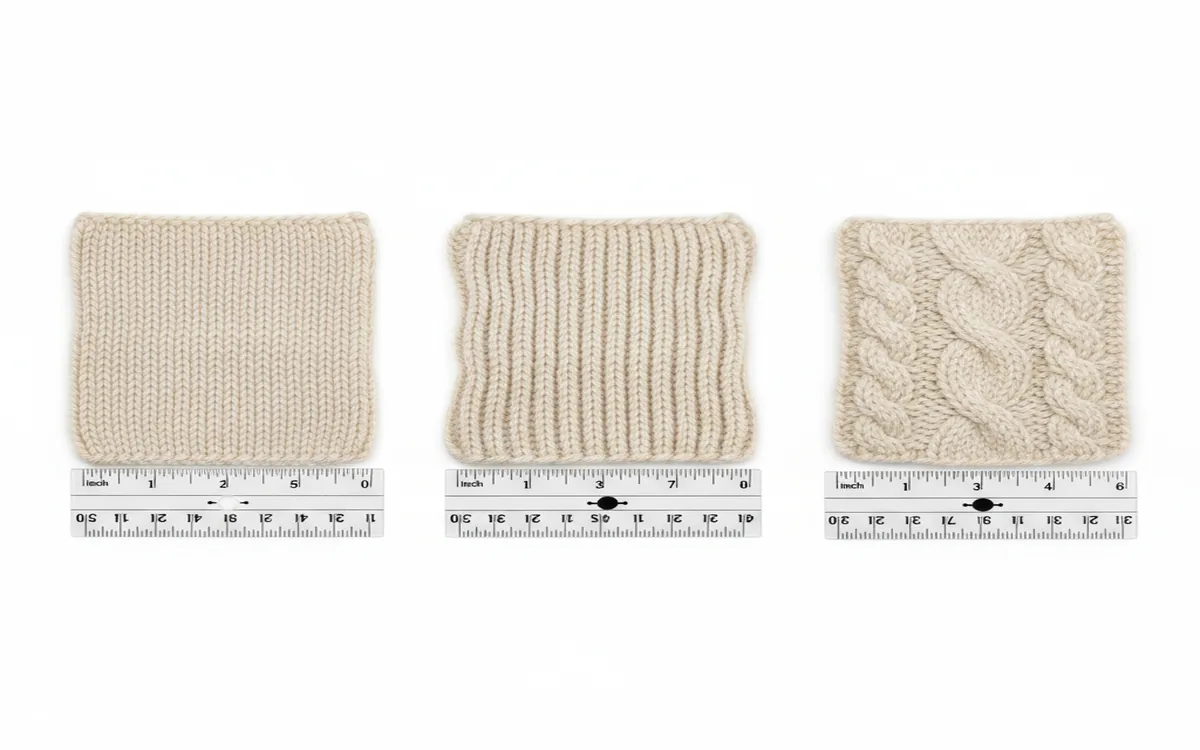
One of the most important things to understand is that gauge is not fixed — it shifts with every stitch pattern, even when yarn and needle size remain constant:
- Ribbing pulls in horizontally, producing a denser horizontal gauge — you will get more stitches per inch than in stockinette
- Cables compress the fabric and pull in laterally, making cable panels narrower than a plain stockinette panel of the same stitch count
- Lace patterns typically spread out after blocking, often producing fewer stitches per inch than unblocked stockinette
- Stranded colorwork is typically 10 to 20 percent tighter than plain stockinette because the carried floats pull the fabric inward
- Seed stitch and moss stitch often produce a slightly different gauge than stockinette, both horizontally and vertically
If your pattern features multiple stitch patterns — for example, a ribbed hem transitioning to a stockinette body with cable panels — the pattern should specify which gauge to match for sizing purposes. Read the gauge note carefully and swatch accordingly.
Recording Your Gauge
Keep a knitting notebook — physical or digital — where you log every gauge swatch you make. For each entry, record:
- Yarn name, brand, weight, and colorway
- Needle size and material (bamboo, metal, plastic, interchangeable tips)
- Stitch pattern used
- Stitches and rows per 4 inches, pre-blocking and post-blocking
- Blocking method used
- Any notes on how the yarn behaved
Over time, this becomes an invaluable personal reference. When you want to substitute a yarn in a future project, you can search your records for yarns that gave you a matching gauge rather than starting from scratch. It also helps you notice patterns in your knitting — for example, that you consistently knit one needle size looser than average, or that a particular fiber always blooms after washing.
The Payoff
Yes, swatching takes time — usually an evening for the knitting, plus drying time. But weigh that against the alternative: investing 40, 60, or 100 hours in a sweater that does not fit, cannot be easily altered, and may not be salvageable. A gauge swatch is the cheapest form of insurance in knitting.
Knitters who swatch consistently make garments that fit consistently. The correlation is direct and universal. There is no shortcut, no workaround, and no substitute for an accurate gauge measurement before you cast on.
Using Your Gauge
Once you have an accurate, post-blocking gauge measurement in hand, you can:
- Follow pattern instructions with full confidence that your sizes will be accurate
- Use a knitting gauge calculator to resize patterns for different measurements or sizes
- Substitute yarns confidently by matching gauge rather than relying on weight category alone
- Generate fully custom patterns with tools like La Maille, which build every stitch count around your exact gauge
- Work top-down or modular designs where gauge governs every proportion
Your gauge is your personal knitting fingerprint. No two knitters have exactly the same gauge with the same materials. Know yours with precision, and you have the foundation to knit any project — any style, any size, any construction — with confidence that the finished fabric will match your intentions.
Frequently Asked Questions
What is knitting gauge? Knitting gauge is the number of stitches and rows you produce per unit of measurement — typically per 4 inches or 10 centimeters — using a specific yarn, needle size, and stitch pattern. It is the mathematical foundation of every measurement in a knitting pattern. Match the gauge, and your garment will match the intended measurements.
Why does gauge matter so much? Because every stitch count in a pattern is calculated from the gauge. A difference of just half a stitch per inch, applied across a 200-stitch body, shifts the circumference by 4 full inches — roughly 1 to 2 sizes. Gauge controls width, depth, and height of every section of a garment.
How do I measure my knitting gauge? Knit a swatch of at least 6 inches square using the correct yarn, needles, and stitch pattern. Bind off, wash, and block the swatch as you would the finished garment. Once fully dry, use a rigid ruler to count stitches and rows over 4 inches in the center of the swatch, avoiding the edges.
What if my gauge doesn't match the pattern? Adjust your needle size. If you have too many stitches (your knitting is tight), go up one needle size and swatch again. If you have too few stitches (your knitting is loose), go down one needle size. Repeat until your gauge matches, or until you are as close as possible.
Do I need to match row gauge exactly? Stitch gauge is the higher priority — it controls the width of your garment, which cannot be adjusted mid-project. Row gauge controls length, which can usually be modified by knitting more or fewer rows before shaping points. Match stitch gauge first; address row gauge discrepancies by adjusting lengths as you knit.
Does gauge change after washing? Yes — often significantly. Wool can bloom and relax, cotton can grow, acrylics can shift depending on how they are processed. Always wash and block your swatch before measuring, using the exact same method you plan to use on the finished garment. A pre-wash gauge reading is unreliable for planning purposes.
Can I use the same gauge swatch for different needle materials? No. Needle material affects how yarn slides and how your tension naturally settles. Metal needles tend to produce slightly looser fabric than bamboo or wood needles for most knitters. Always swatch with the exact needle you plan to use for the project — same size and same material.
Ready to put your gauge to work? Try La Maille — enter your gauge and measurements to generate a fully custom pattern built around your exact numbers, so your finished garment fits perfectly from the very first row.