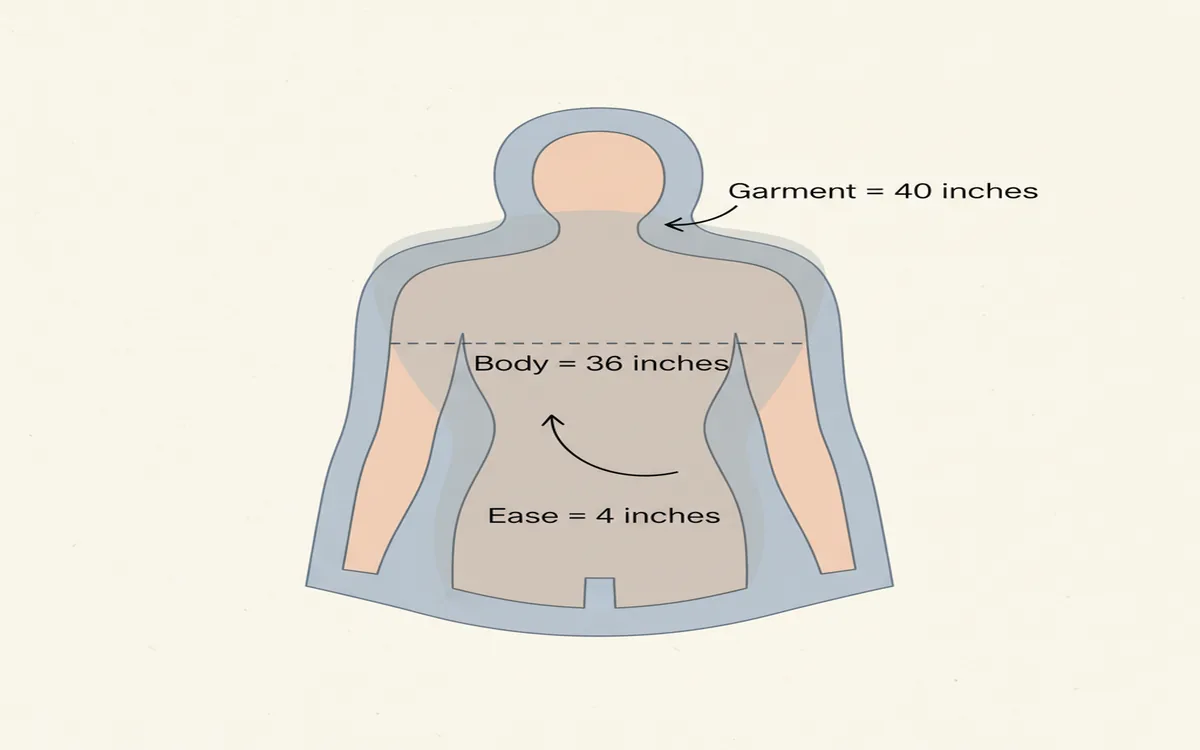
Ease in knitting is the difference between your body measurement and the finished garment measurement. If you have a 38-inch bust and you wear a sweater with a 42-inch finished bust, that garment has 4 inches of positive ease. Standard sweater ease ranges from 2 to 4 inches for a comfortable, everyday fit, making it one of the most consequential decisions you'll make when choosing a pattern size. Ease affects how a garment drapes, how freely you can move, whether you can layer underneath, and ultimately whether a finished sweater gets worn or sits in a drawer. Understanding ease is essential whether you're selecting a size from a commercial pattern, altering an existing design, or using a tool like La Maille to generate a fully custom-fitted pattern from your own measurements.
What Is Ease?
Ease is the numerical difference between your actual body measurements and the finished measurements of a knitted garment. It is expressed in inches or centimeters, and it can be positive, zero, or negative.
If your bust measures 38 inches and your sweater's finished bust is 42 inches, that sweater has 4 inches of ease. If your sweater's finished bust is 38 inches, it has zero ease. If the sweater measures 36 inches finished, it has 2 inches of negative ease.
Simple arithmetic, but the implications for fit — and for comfort — are enormous. A single inch of ease can be the difference between a sweater that feels relaxed and one that pulls across the back. Two inches can shift a garment from "fitted and tailored" to "boxy and casual." Getting ease right is the single most powerful tool you have for predictable, repeatable fit.
It is also worth noting that ease is not a flaw or a workaround. It is a deliberate design choice built into every well-constructed garment. Professional pattern designers specify ease intentionally. When you understand what they intended, you can decide whether it matches what you want — and adjust accordingly.
Types of Ease
Positive Ease
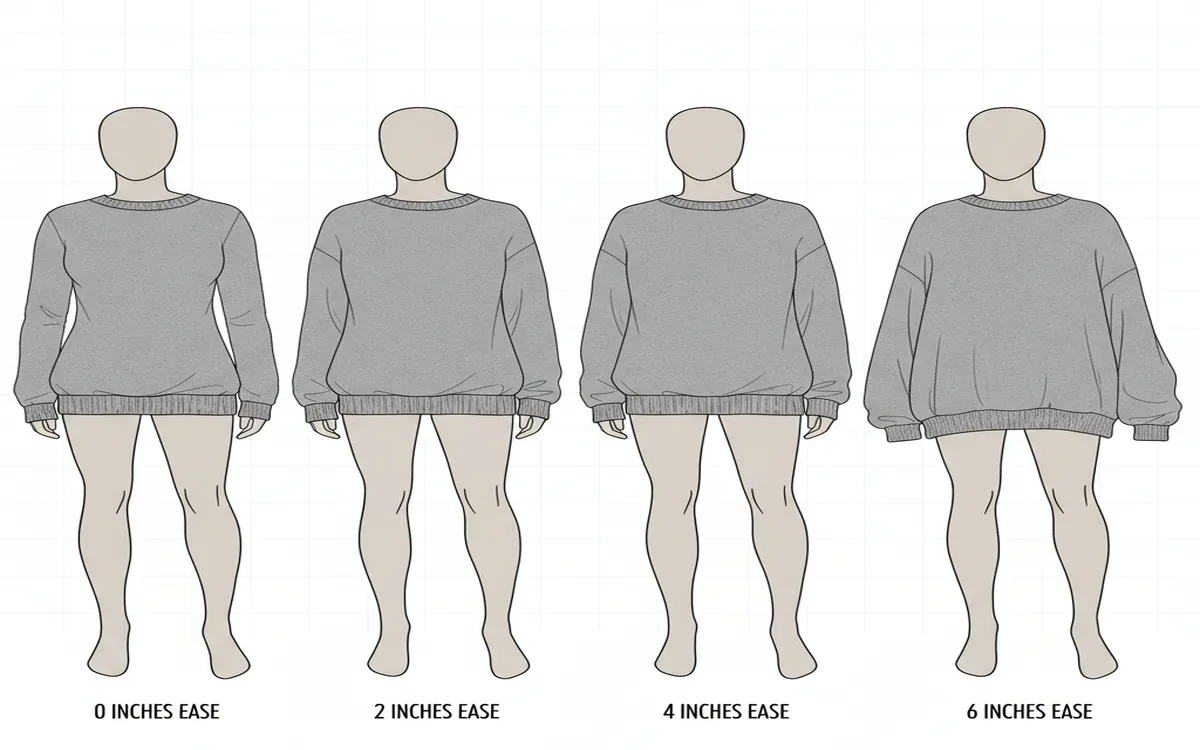
Positive ease means the finished garment is larger than your body measurements. The vast majority of sweaters, cardigans, and pullovers are designed with positive ease. The fabric does not cling to the body, there is room to breathe and move, and you can comfortably layer a shirt or tank top underneath.
Here is a practical breakdown of positive ease ranges and what they look like in practice:
- 1–2 inches: Very fitted. Fabric skims the body closely without clinging. Works well in structured wools and smooth yarns with good stitch definition.
- 2–4 inches: Standard fit. The most common range for everyday sweaters. Comfortable without looking baggy. Suitable for most body types and yarn weights.
- 4–6 inches: Relaxed fit. Noticeably roomier. Great for casual wear, working from home, or anyone who prefers not to feel fabric against their body.
- 6–8 inches: Oversized. Deliberately loose and fashion-forward. Sleeves may be intentionally long; the body hangs away from the torso.
- 8+ inches: Very oversized. A deliberate aesthetic choice. Think big cozy sweaters, cocoon cardigans, and chunky knit statements.
Most knitting patterns fall somewhere in the 2–6 inch positive ease range, though current fashion trends have pushed many designs toward the 4–8 inch range.
Zero Ease
Zero ease means the finished garment measures exactly the same as your body. In rigid fabrics like woven cloth, zero ease would feel uncomfortably tight. In knitting, however, zero ease actually produces a somewhat fitted but wearable result — because knitted fabric has inherent stretch and give.
A sweater knit with zero ease will feel snug when you first pull it on, but once it settles, the fabric's natural elasticity accommodates your shape. Whether you find zero ease comfortable depends on your yarn (more elastic fibers like wool stretch more generously than cotton), your gauge (a looser gauge has more give), and your own personal preference for how clothes feel against your body.
Negative Ease
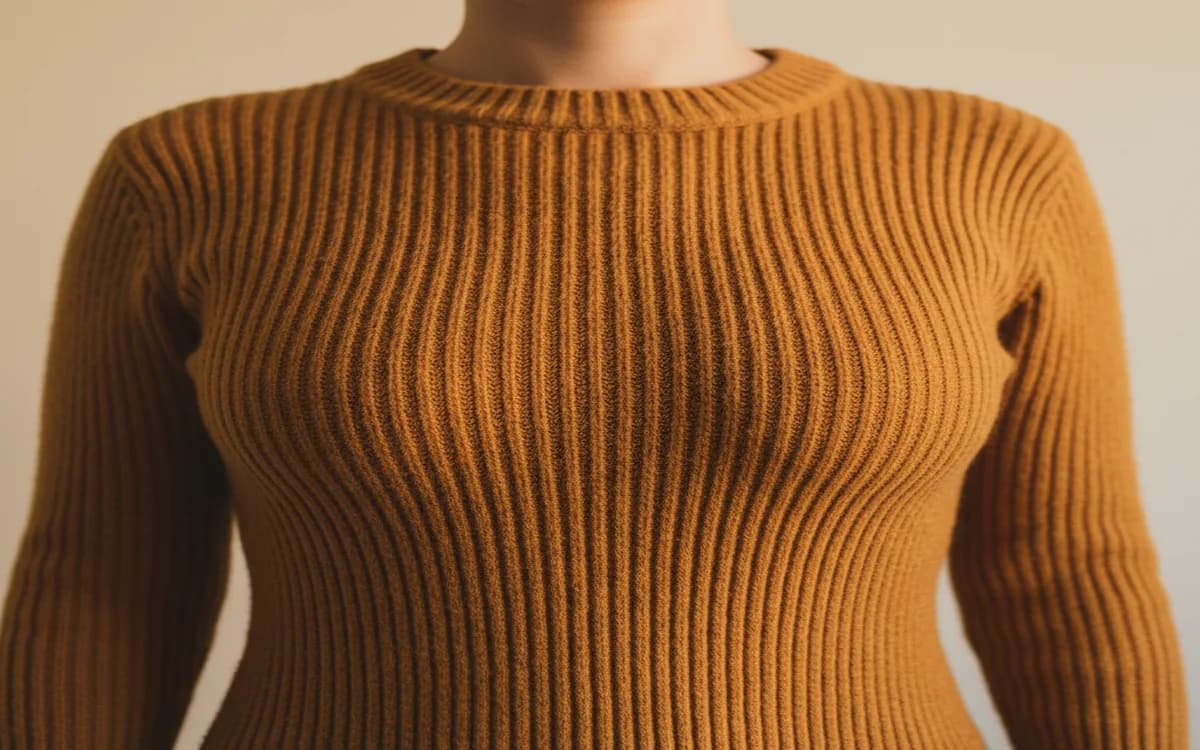
Negative ease means the finished garment is smaller than your body measurements. The garment relies entirely on the fabric's stretch and elasticity to fit. This sounds counterintuitive — why would you knit something smaller than your body? — but it is the standard approach for several categories of knitted items.
Negative ease is common in:
- Ribbed garments, where the columns of knit and purl stitches compress and then spring back
- Athletic or close-fitting wear where the fabric should hug the body
- Socks and gloves, where a snug fit prevents bunching and improves comfort
- Close-fitting hats and beanies, where negative ease keeps the hat on your head
A standard sock is typically knit with 10% negative ease relative to the foot circumference. For a foot measuring 8 inches around, that means knitting a sock approximately 7.2 inches in circumference. The sock stretches to fit and grips the foot without slipping. A hat for a 22-inch head might be knit to 20–21 inches in circumference for a comfortable, secure fit.
The key to negative ease working well is choosing the right fiber and stitch pattern. Yarns with high wool content or elastane are far better suited to negative ease than cotton or linen, which have minimal stretch.
Why Ease Matters
Two sweaters knit from the same pattern, with the same yarn, to identical finished measurements — but worn by different bodies — will fit completely differently.
Example: A pattern states that the finished bust measurement is 40 inches.
- Person A has a 36-inch bust → 4 inches of positive ease → a relaxed, casual fit
- Person B has a 40-inch bust → 0 inches of ease → a snug, form-skimming fit
- Person C has a 42-inch bust → 2 inches of negative ease → likely uncomfortable and restrictive
Same pattern. Same yarn. Same numbers. Three entirely different wearing experiences.
This is why choosing a pattern size by the size label alone — Small, Medium, Large — is unreliable. Sizing conventions vary significantly between designers, brands, and even countries. The only number that matters is the finished garment measurement, compared against your own body measurement, with your ease preference factored in. Our guide on how to measure yourself for a knitted sweater shows exactly how to take those body measurements.
How Patterns Handle Ease
Most knitting patterns provide the finished measurements and expect the knitter to choose a size based on how much ease they prefer. The quality and clarity of this information varies widely.
Good patterns include a finished measurements schematic — a flat drawing of the garment with all key dimensions labeled — and note the recommended ease in the pattern introduction. They might say something like "this sweater is designed for 3–5 inches of positive ease at the bust."
Better patterns explicitly tell you what body measurements each size is designed for. This removes the guesswork. If the size medium says "for a 36–38 inch body bust, finished garment measures 42 inches," you know immediately that the designed-in ease is 4–6 inches.
Frustrating patterns provide only size labels (XS, S, M, L, XL) with no measurements, or provide finished measurements without any guidance on intended ease or the body size the design was made for. These patterns require more detective work on your part, which is where understanding ease becomes even more critical.
Choosing the Right Ease
Your ideal ease depends on several overlapping factors that are worth thinking through before you cast on a single stitch.
Personal Preference
Some knitters love the clean, tailored look of a close-fitting sweater. Others feel physically restricted by anything that fits snugly around the torso or upper arms. Neither preference is wrong — it is simply a matter of knowing yourself. A useful exercise: go to your wardrobe and pull out three or four tops you reach for most often. How do they fit? That is your ease preference, even if you've never called it that.
Garment Style
The type of garment you are knitting strongly suggests an appropriate ease range:
- Fitted cardigans: 1–2 inches of positive ease
- Classic crew-neck pullovers: 2–4 inches
- Casual weekend sweaters: 3–5 inches
- Cozy oversized knits: 6–10 inches
- Ribbed turtlenecks: 0–2 inches, sometimes negative
- Socks: 10% negative ease relative to foot circumference
- Hats: 1–2 inches of negative ease relative to head circumference
Always look carefully at the pattern photos. The way the garment sits on the model — whether it hugs the body or hangs away — gives you a visual cue for the intended ease. If the model in the photo is wearing a relaxed, drapey fit, you should expect 4 or more inches of ease.
Yarn and Fabric
Fiber content and construction significantly influence how ease feels in practice.
- Drapey fabrics (silk, bamboo, Tencel, or loosely spun blends): Flow over the body's curves and often need less ease than you might expect. A 2-inch ease in a fluid silk-blend yarn looks completely different from 2 inches in a firm worsted wool.
- Structured fabrics (tightly spun wool, cotton at a firm gauge): Sit away from the body with less drape. These typically benefit from slightly more ease to avoid feeling stiff or boxy.
- Ribbed fabrics: The most stretchy of all knitted textures. Ribbing can handle negative ease comfortably, and in fact works best with it. A fully ribbed sweater at 2 inches of negative ease will feel hugging but not tight.
- Textured stitch patterns (cables, seed stitch, bobbles): These compress the fabric horizontally, effectively reducing the finished width. If your sweater is heavily cabled, you may need to add extra ease to compensate for the draw-in.
Activity and Layering
Consider how you will actually use the garment. A sweater worn while sitting at a desk has different needs than one worn for hiking or cycling. If you plan to layer over a button-down shirt or a light jacket, you need to add enough ease to accommodate those layers comfortably — typically at least 1 extra inch for a light layer, 2 or more for a thicker one.
How to Determine Ease in a Pattern
There are three reliable methods for figuring out how much ease is built into a pattern.
Method 1: Read the pattern notes
Many designers state the intended ease directly in the pattern introduction. Look for phrases like "designed for 2–4 inches of positive ease" or "this is a fitted silhouette with minimal ease." If the designer has done this work for you, use it.
Method 2: Compare the measurements
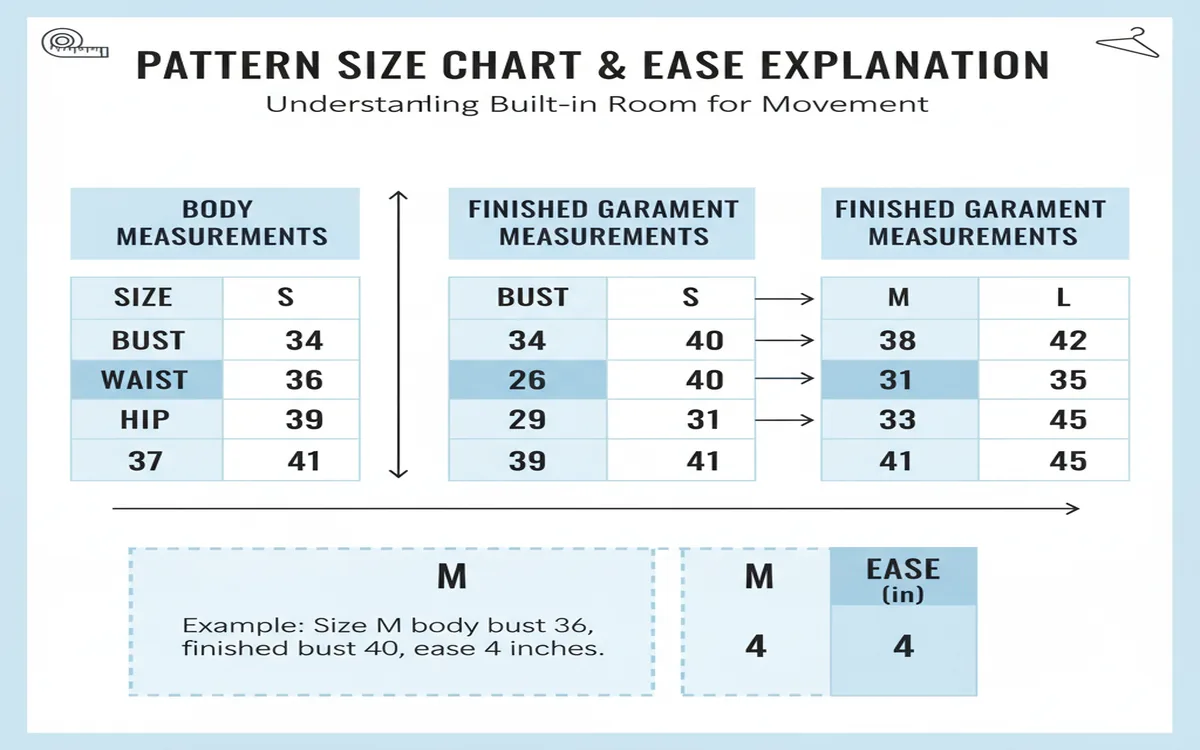
Find the body measurements the pattern was designed for — sometimes listed in a separate column of the size chart — and compare them to the finished measurements. The difference is the built-in ease. For example, if size L is designed for a 42-inch body bust and the finished bust is 46 inches, the ease is 4 inches.
Method 3: Analyze the size range
If a pattern lists size M as fitting a 36–38 inch bust with a finished measurement of 42 inches, you can infer that someone with a 36-inch bust would have 6 inches of ease, and someone with a 38-inch bust would have 4 inches of ease. The designer likely intended this size for the 36–38 inch range, meaning the target ease is somewhere between 4 and 6 inches.
Measuring Ease in Your Existing Clothes
One of the most practical ease-related exercises you can do requires no math beyond basic subtraction. Find a sweater or top in your wardrobe that fits exactly the way you wish all your knits would fit. Lay it flat on a table and measure straight across the chest, just below the underarms. Multiply that number by 2 to get the full circumference.
Now subtract your actual bust measurement. The result is your personal preferred ease for that style of garment. Write it down. Use it every time you choose a pattern size.
This method is far more reliable than following a size chart blindly because it is calibrated to your body and your preferences simultaneously.
Ease and Pattern Generation
When you use a tool like La Maille to generate a custom pattern, you typically input your body measurements directly. The tool then asks about desired ease or fit style and calculates the pattern dimensions accordingly. This eliminates the most frustrating part of working with commercial patterns — reverse-engineering the intended ease from a size chart that may not account for your proportions.
Custom pattern generation is particularly useful for knitters whose measurements do not follow standard size proportions. If you have a larger cup size, a longer torso, a wider back, or narrower shoulders relative to your bust, a custom ease calculation gives you a far better starting point than any commercial size chart.
Common Ease Mistakes
Even experienced knitters make ease-related errors. Here are the most frequent ones and how to avoid them.
Choosing pattern size by body measurement alone: If your bust is 38 inches and you select the 38-inch size, you may end up with zero ease — a snug, form-fitting sweater — when you expected something comfortable and relaxed. Always compare the finished garment measurements to your body.
Not accounting for ease preference: If you consistently wear loose, flowing clothes, a pattern designed for 1–2 inches of ease will feel restrictive on your body even if it technically fits. Choose a size with more positive ease, or size up deliberately.
Ignoring fabric-specific behavior: A sweater with 2 inches of ease in a sturdy Aran-weight wool fits and behaves very differently from 2 inches of ease in a lightweight, drapey silk-merino blend. Factor in how the yarn moves before committing to a size.
Forgetting about layering: A sweater you plan to wear over a thick flannel shirt needs significantly more ease than one worn over a thin tank top. If layering is part of your plan, add at least 1.5–2 extra inches of ease at the bust.
Ignoring ease at points other than the bust: Ease matters across the entire garment, not just at the chest. A sweater can fit perfectly at the bust and still bind uncomfortably across the upper back or upper arm.
Ease at Different Points
Ease is a full-garment consideration, not just a bust measurement. A well-fitting sweater has appropriate ease at every key measurement point.
- Shoulder ease: Affects range of motion. Too-narrow shoulders restrict arm movement and cause the sweater to pull forward.
- Upper sleeve ease: The most commonly overlooked measurement. Too tight at the upper arm is one of the most uncomfortable fit problems in knitwear. Aim for at least 1–2 inches of ease at the widest point of the upper arm.
- Hip ease: Critical if the sweater hem falls below the waist or over the hips. A sweater that fits at the bust but pulls at the hip will ride up constantly.
- Neckline ease: While not usually measured as ease, a neckline that is too tight or too loose affects both comfort and appearance dramatically.
- Sleeve length: Not technically ease, but a longer or shorter sleeve changes how the garment reads and feels as much as ease does.
Thinking about ease at all these points — not just the bust — is what separates a sweater that fits from a sweater that fits well.
The Bottom Line
Understanding ease transforms your knitting practice from "follow the size chart and hope for the best" into a deliberate, confident process. You are no longer at the mercy of a designer's size conventions or a model's proportions. You choose the fit you want, you calculate the ease you need, and you select the size — or generate the pattern — accordingly.
Always: 1. Know your measurements — bust, upper arm, hips, and torso length at minimum 2. Check the pattern's finished measurements at every key point 3. Calculate the ease for each available size 4. Choose based on your preference and the garment's intended style, not just the size label
Frequently Asked Questions
What is ease in knitting? Ease is the difference between your body measurement and the finished garment measurement. A 38-inch bust wearing a sweater with a 42-inch finished bust has 4 inches of positive ease. Ease can be positive (garment larger than body), zero (garment equals body), or negative (garment smaller than body, relying on fabric stretch).
How much ease should a sweater have? It depends on the style and your personal preference. A close-fitting sweater typically has 1–2 inches. A standard comfortable fit uses 2–4 inches. A relaxed casual sweater has 4–6 inches. An oversized silhouette starts at 6 inches and goes up. The pattern's photos are the best visual guide to the designer's intended ease.
What's the difference between positive and negative ease? Positive ease means the finished garment is larger than your body measurement — the most common approach for sweaters and cardigans. Negative ease means the garment is smaller than your body, relying on the fabric's stretch and elasticity to fit. Negative ease is standard for socks, hats, ribbed garments, and athletic wear.
How do I know what ease a pattern includes? Compare the pattern's finished measurements to the body measurements it is designed for. The numerical difference is the built-in ease. If a pattern lists both body measurements and finished measurements in its size chart, the subtraction is simple. If it only lists finished measurements, compare those to your own body measurements.
Can I change the ease in a pattern? Yes, absolutely. Choosing a larger size gives you more positive ease; choosing a smaller size gives you less. Alternatively, calculate your ideal finished measurement — your body measurement plus your desired ease — and find the pattern size whose finished measurements come closest to that number. This is the most reliable method for getting a predictable fit.
Does fiber content affect how much ease I need? Yes, significantly. Drapey fibers like silk, bamboo, and Tencel flow over the body and often need less ease. Structured fibers like tightly spun wool or cotton sit away from the body and may need slightly more ease for comfort. Ribbed fabrics stretch the most and can be knit with negative ease comfortably, while heavily cabled fabrics draw in and may need extra ease to compensate.
What happens if I pick the wrong ease? A sweater with too little ease will feel tight, restrict movement, and may pull across the back or bust. A sweater with too much ease may feel sloppy or slide off the shoulders. Neither is catastrophic — you can learn from it — but calculating ease deliberately before casting on is always worth the ten minutes it takes.
Ready to get the perfect fit every time? Try La Maille — enter your body measurements and desired fit style to generate a custom pattern built around exactly the ease you want.