You can resize any knitting pattern by recalculating stitch counts using your gauge: multiply your desired measurement in inches by your stitches per inch, then adjust all shaping proportionally. The average hand-knit sweater takes 40–80 hours to complete, so getting the size right before you start is critical. Whether you resize manually or use tools like La Maille to generate a pattern for your exact measurements, understanding the math behind resizing makes you a more confident, independent knitter. This guide walks through every step — from gathering your measurements to recalculating complex shaping — so you can adjust any knitting pattern to fit your body perfectly.
Before You Start: Gather Information
Successful pattern resizing depends entirely on having accurate information before you touch a single stitch. Rushing this stage is the most common reason adjustments fail. Take 15–20 minutes to pull everything together before you start doing any math.
You'll need:
- Your gauge swatch: Know exactly how many stitches and rows per inch you get with your yarn and needles. Wash and block your swatch before measuring — gauge can change by 5–10% after blocking, which makes a significant difference across a 40-inch garment.
- Your measurements: Bust, waist, hip, body length, arm length, and upper arm circumference at minimum. For a close-fitting garment, also measure your cross-back width and shoulder slope.
- The pattern's measurements: Most patterns include a finished measurements schematic. Use the finished measurements, not the body measurements — the pattern designer already built in their intended ease.
- A calculator: You'll be doing math. A spreadsheet app on your phone works well for tracking multiple sections at once.
- The pattern's original gauge: Compare it to your gauge. If the pattern calls for 4.5 stitches per inch and you're getting 5 stitches per inch, you already know the pattern will knit up smaller at the same stitch count — which is exactly why we recalculate.
The Basic Principle
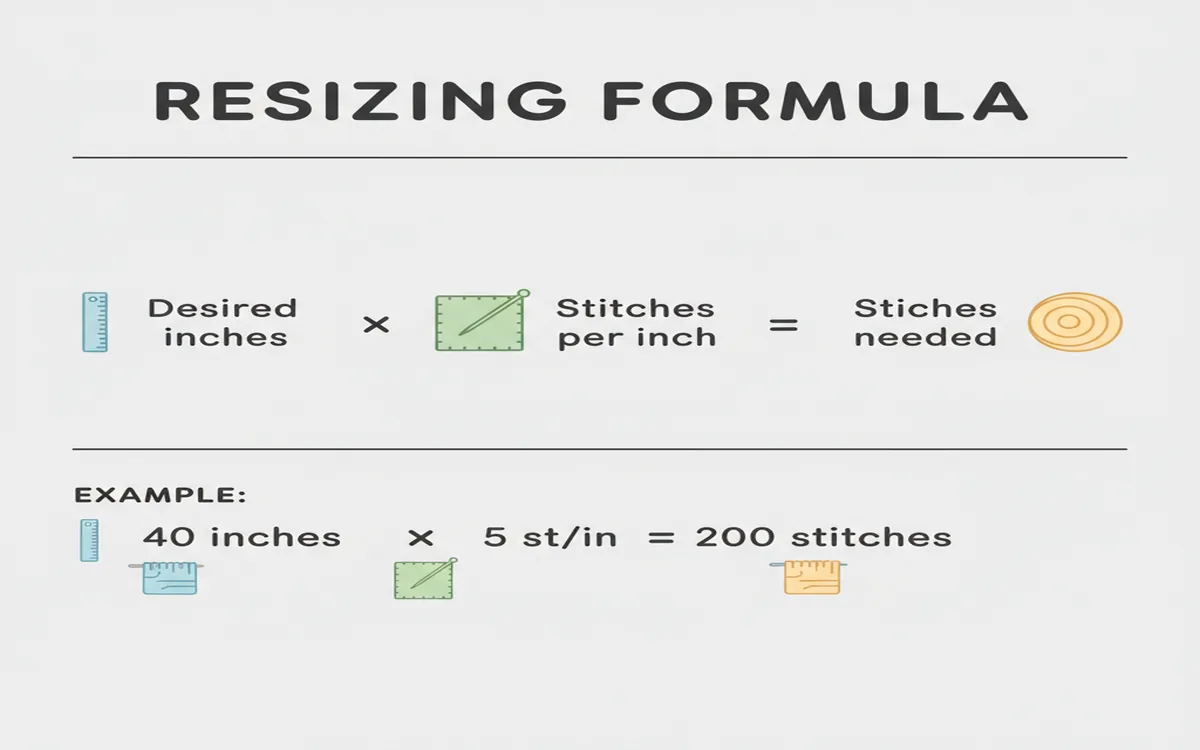
Resizing works on a simple principle: if you know how many stitches make one inch, you can calculate how many stitches make any measurement.
Stitches needed = Desired inches × Stitches per inch
If your gauge is 5 stitches per inch and you want a 40-inch bust, you need 200 stitches. If your gauge is 4 stitches per inch and you want the same 40-inch bust, you need 160 stitches. The target measurement stays the same; the stitch count changes to suit your yarn and needle combination.
This same formula applies to every part of the garment: waist, hips, upper arm, wrist, neckline. Every width measurement in a knitting pattern is just a stitch count translated from inches (or centimeters). Once you internalize that, resizing feels far less intimidating.
The row gauge matters too — especially for length calculations. Rows needed = Desired inches × Rows per inch. If you have 7 rows per inch and need an 18-inch sleeve, you're working 126 rows total.
Step 1: Determine Your Target Measurements
Start with your body measurements and add ease for the fit you want:
- Close fit: Add 0–2 inches of ease
- Standard fit: Add 2–4 inches of ease
- Relaxed fit: Add 4–6 inches of ease
- Oversized: Add 6+ inches of ease
Example: Your bust is 38 inches and you want a standard fit. Target bust = 38 + 3 = 41 inches.
Ease is a design choice, and it varies by garment type. A fitted cardigan might use 1 inch of ease; a cozy pullover might use 5 inches. Look at the pattern's schematic to understand what ease the original designer intended, and decide whether you want to replicate that feeling or change it. If the pattern's finished bust is 44 inches and the target size is written for a 40-inch body, that's 4 inches of positive ease — and you should account for the same amount when calculating for your own bust measurement.
Write down every target measurement in a table before proceeding. Having all your numbers in one place prevents confusion when you're deep in shaping calculations.
Step 2: Calculate New Stitch Counts
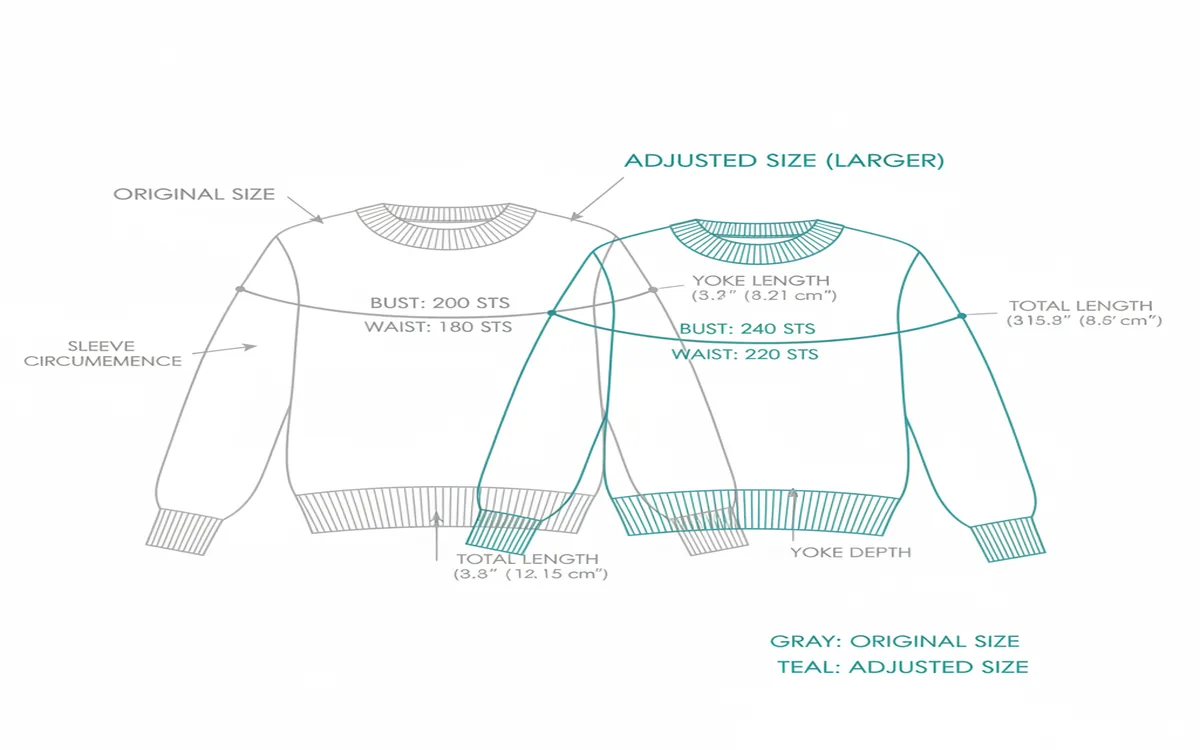
Using your gauge, calculate the number of stitches for each measurement.
For a pullover knit in the round at 5 stitches per inch:
- Target bust: 41 inches
- Total stitches: 41 × 5 = 205 stitches
Round to match your stitch pattern repeat if needed. If you're using a 4-stitch repeat pattern, round to 204 or 208. If you're using a 6-stitch repeat with a 2-stitch border on each side, your adjustable section must be divisible by 6. Always check the stitch repeat before finalizing your cast-on number — even one or two stitches off can throw off an entire colorwork or cable section.
For a cardigan knit flat:
- Each front panel = roughly (41 ÷ 4) stitches, accounting for button bands
- Back = 41 ÷ 2 in stitches = approximately 102–103 stitches
For cardigans, also subtract the width of your button bands from the total width before dividing into sections. A typical button band is 8–12 stitches wide, depending on the yarn weight.
Step 3: Recalculate Shaping
Here's where resizing gets more complex. You need to adjust shaping to match your new stitch counts. Think of the original pattern's shaping as a ratio — your job is to reproduce the same proportional effect with your new stitch count.
Waist Shaping
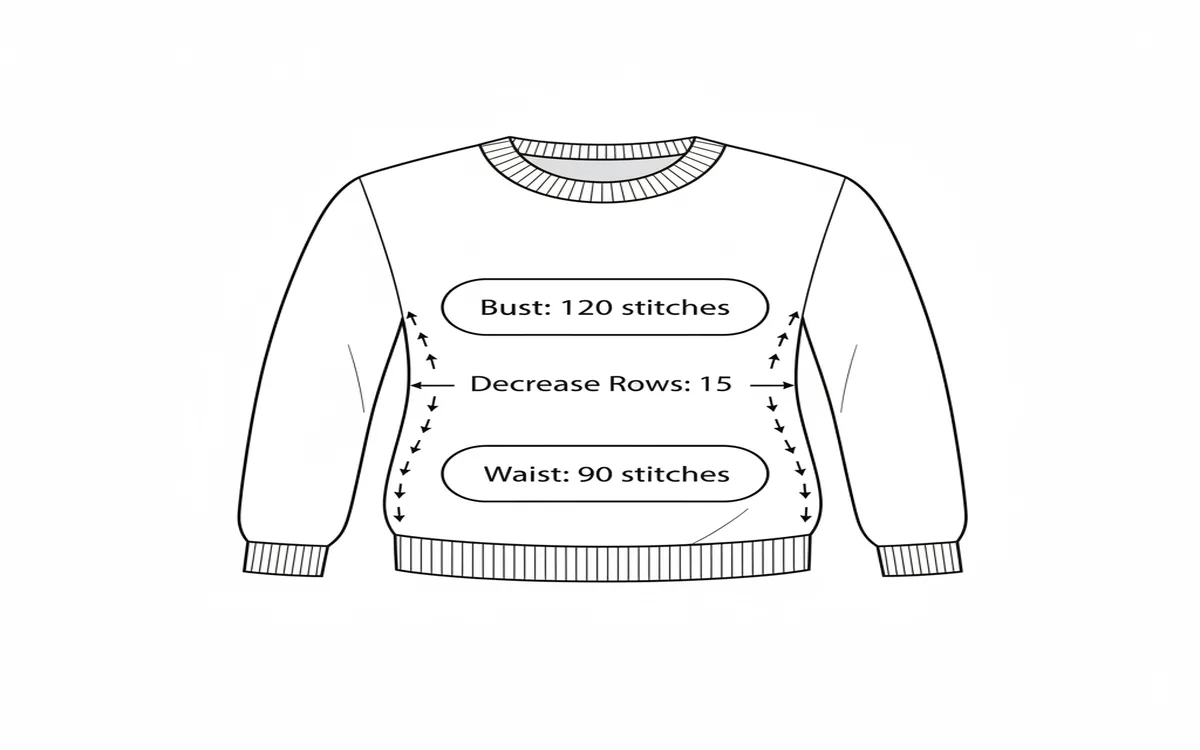
If the original pattern decreases 4 stitches at the waist: 1. Calculate how many stitches you need at the waist (waist measurement × gauge) 2. Subtract from bust stitches to find how many to decrease 3. Distribute decreases evenly over the waist-shaping section
Example: Bust is 205 stitches, waist needs 180 stitches. You need to decrease 25 stitches total. Round to 24 for even distribution: 6 decrease rows, 4 stitches decreased per row (2 stitches decreased at each side seam, front and back). Then work an equal number of increase rows to return to bust circumference before the armhole.
A good rule of thumb: spread your waist shaping over 3–5 inches of fabric for a natural-looking curve. If your row gauge is 7 rows per inch and you want to work 4 inches of decreases, you have about 28 rows. Dividing 6 decrease rounds into 28 rows means decreasing every 4–5 rows.
Armhole Shaping
Armhole shaping is one of the trickier parts of any pattern resize. Look at the pattern's armhole depth and bind-off amounts, and compare them to your own cross-back and shoulder measurements.
You may need to:
- Adjust the initial bind-off for a larger or smaller armhole opening
- Add or remove rows for a deeper or shallower armhole depth
- Recalculate shoulder stitches to match your actual shoulder width
A useful guideline: armhole depth is typically 7–10 inches for adults, with larger sizes needing more depth. For a size where the finished bust is 44–50 inches, expect an armhole depth of 8.5–10 inches. For a 36–40 inch bust, 7–8 inches is common. Measure your own cross-back width (shoulder point to shoulder point across the back) to get the most accurate target.
The initial bind-off at the underarm is usually 4–8% of your total body stitches — a larger garment needs a slightly wider bind-off to create a smooth underarm curve.
Sleeve Shaping
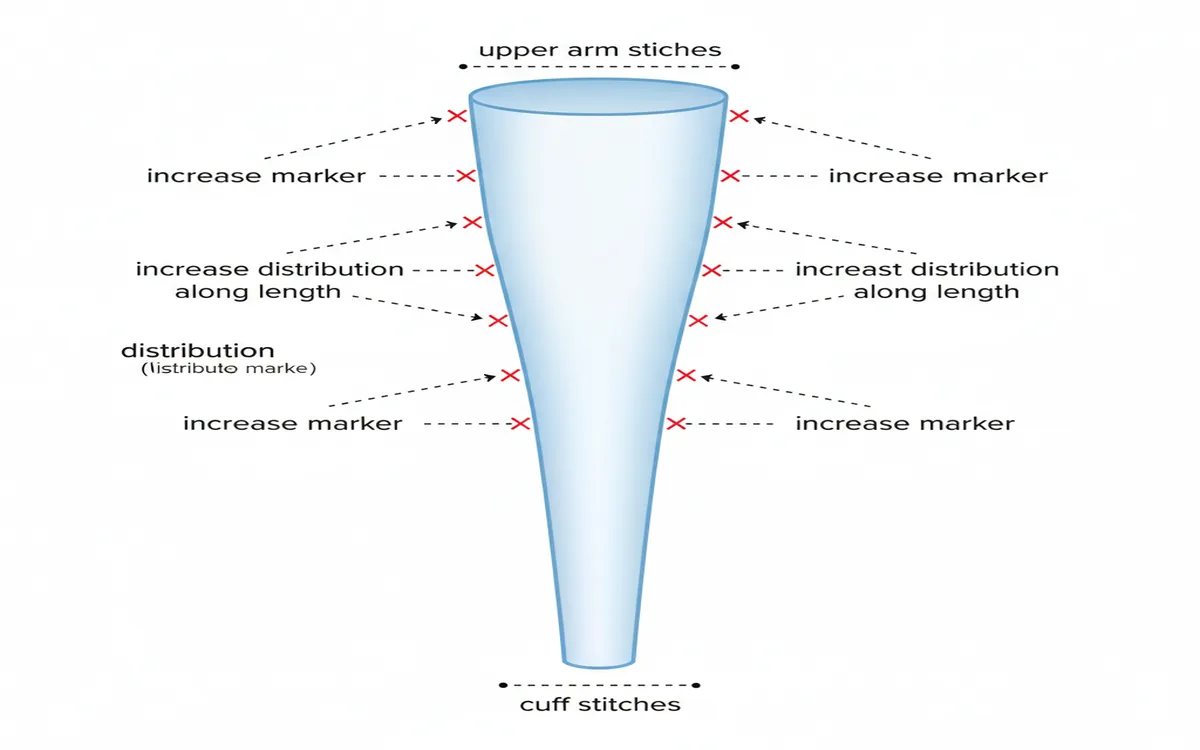
Sleeves need resizing at three key points:
- Upper arm: Calculate stitches for your upper arm measurement plus 2–4 inches of ease for a standard fit
- Cuff: Calculate stitches for your wrist measurement plus ease — a snug cuff is typically 7–8 inches finished; a relaxed cuff is 8–10 inches
- Length: Use your actual arm measurement from underarm to wrist
Then figure out how to get from cuff stitches to upper arm stitches over your arm length in rows.
Example: Cuff = 40 stitches, upper arm = 70 stitches, arm length = 18 inches (18 × 6 rows per inch = 108 rows).
- Stitches to add: 70 − 40 = 30 stitches (15 increases on each side)
- Increase frequency: 108 ÷ 15 = increase every 7 rows (approximately)
In practice, you may need to work the last few rows even (without increases) if the numbers don't divide cleanly. That's normal — a row or two of even knitting at the top of the sleeve before the sleeve cap won't affect the final look.
Also recalculate the sleeve cap. Sleeve cap height is typically 50–60% of the armhole depth. If your armhole is 8 inches deep, your sleeve cap should be approximately 4–5 inches tall. The total sleeve cap stitch count must match the armhole opening you created.
Step 4: Check Proportions
When you change one measurement, make sure everything else still works together. Garment proportions are interrelated — the bust affects the shoulder, which affects the armhole, which affects the sleeve cap.
Key proportion checks:
- Shoulder width: Should be approximately 30–35% of the total back width. If your back is 20 inches wide, shoulders should be about 6–7 inches each (12–14 inches total).
- Armhole depth: Verify the depth works for your cross-back measurement, not just your bust size. Some people have wide shoulders relative to their bust and need a deeper armhole.
- Body length: May need adjustment if you're significantly shorter or taller than the pattern assumes. Most patterns are drafted for a height of around 5'4"–5'7". If you're 5'10", you may need to add 1–2 inches to the body and sleeve lengths.
- Neckline width: Should feel balanced relative to your shoulder width. If you've significantly changed the shoulder stitches, check that the neckline hasn't become disproportionately wide or narrow.
Sketching a quick schematic — even a rough one — helps you visualize whether all the numbers feel right before you cast on.
Step 5: Make Notes and Track Changes
Document every modification as you go:
- New stitch counts for each section
- New shaping instructions (how many stitches, how often, over how many rows)
- Rows to work even before each shaping section begins
- Any stitch repeat adjustments you made
Write it out row by row if needed. A simple notebook, a notes app, or a spreadsheet all work well. Future you will be extremely grateful when you're 60 rows into the body and need to remember exactly when to start the armhole shaping.
If you're modifying a printed pattern, consider writing your new numbers directly above the original numbers in pencil so you can follow the structure of the pattern with your new values substituted in.
Common Resizing Scenarios
Making a Pattern Larger
When adding significant width — more than 2 sizes — be particularly careful about:
- Increasing cast-on stitches proportionally across every section
- Checking that armholes are deep enough (larger sizes genuinely need deeper armholes, not just wider ones)
- Lengthening the body if the pattern assumes a shorter torso
- Verifying that neckline stitch counts still produce a reasonable opening
- Adding sleeve width at the upper arm to match the larger armhole
Making a Pattern Smaller
When removing significant width:
- Decrease cast-on stitches proportionally
- Shallower armholes may be needed for narrower shoulders
- Shorter body length often looks more proportional on a smaller frame
- The neckline may need to be narrowed slightly to stay balanced
Length-Only Adjustments
This is the easiest modification and requires no stitch count changes:
- Add or remove rows in the straight sections before shaping begins
- Keep all stitch counts exactly the same
- Never add or remove rows within a shaping section — only in the even rows between shaping events
- For sleeves, add or remove rows in the straight section between the cuff ribbing and the first increase row
Width in One Area Only
Sometimes you need more room in just one area — the bust, hips, or upper arm:
- Full bust adjustment: Add short rows to the front only to create extra room across the bust without changing the overall width
- Hip adjustments: Cast on extra stitches at the hip and decrease to the standard waist count over 3–4 inches; this adds 1–2 inches of hip ease without changing the rest of the garment
- Upper arm only: Increase the upper arm stitches by 4–8 and adjust the sleeve cap accordingly, keeping the cuff the same
When Resizing Gets Too Complex
Some patterns resist easy resizing, and it's worth knowing when to stop and reconsider your approach:
- Heavy colorwork with specific stitch repeats that can't be changed without disrupting the motif
- Complex cable panels that rely on fixed stitch multiples across the entire width
- Extremely fitted garments with multiple overlapping shaping zones
- Unusual constructions like modular knitting, entrelac, or seamless yoke patterns where every section connects mathematically to every other
In these cases, consider:
- Finding a similar pattern that already comes in your size
- Using the design as visual inspiration and drafting your own pattern from scratch
- Generating a custom pattern with a tool like La Maille, which builds the pattern around your measurements rather than asking you to modify an existing one
The Grading Approach
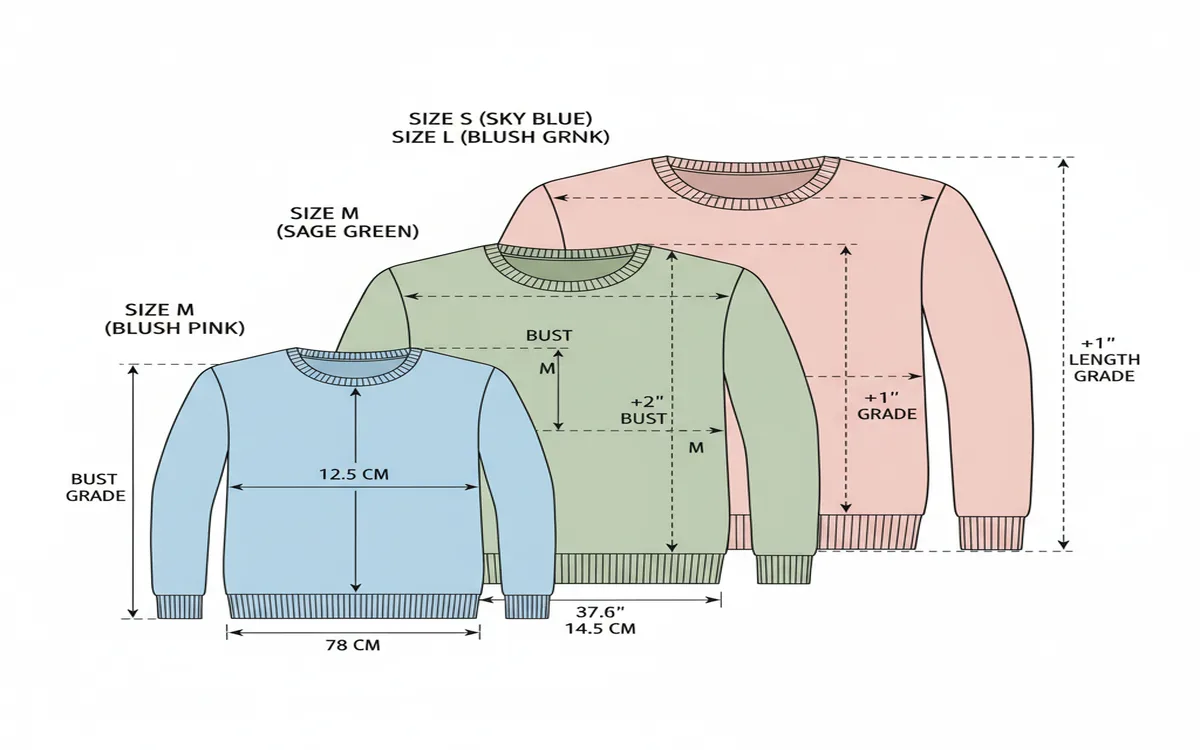
Professional pattern designers use "grading" — a system where each size is calculated by adding or removing consistent amounts at specific points in the pattern. A well-graded pattern typically adds 2 inches of finished bust circumference per size, with corresponding adjustments to the armhole, sleeve, and neckline.
If your target size falls between two sizes in a pattern, you can often interpolate:
- Size M: 200 stitches, Size L: 220 stitches
- You need approximately Size M.5: about 210 stitches
This interpolation works well for simple modifications where you're close to a standard size. It becomes less reliable when you're blending sizes across multiple measurement areas — for example, following one size at the hip, a different size at the bust, and yet another at the shoulder.
Blending sizes is a legitimate technique known as multi-size grading. Work out exactly where the size transitions need to happen (usually at the waist-to-bust shaping or at the armhole) and follow the appropriate size instructions for each section.
An Easier Alternative
Resizing patterns is a valuable skill, but it's also time-consuming and error-prone — particularly for complex garments with multiple shaping zones. Even experienced knitters sometimes spend an hour or more recalculating a pattern before casting on.
Tools like La Maille take a fundamentally different approach: instead of modifying an existing pattern, you input your measurements and gauge, and receive a pattern generated specifically for your body. No manual math required. This is especially useful when:
- You're not yet confident in your pattern math
- You want to recreate a sweater you saw (not from an existing pattern)
- You're working with unusual proportions — long torso, wide shoulders, full bust
- You want to try multiple size variations quickly without recalculating from scratch each time
That said, understanding how to resize a pattern manually makes you a better knitter regardless of what tools you use. When you know why a pattern is shaped the way it is, you can spot errors, make on-the-fly adjustments, and troubleshoot fit issues mid-project rather than only after you've finished.
Frequently Asked Questions
How do I resize a knitting pattern? Calculate new stitch counts using your gauge: desired inches × stitches per inch = stitches needed. Apply this formula to every width measurement in the pattern — bust, waist, upper arm, cuff — then proportionally adjust all shaping sections (armholes, waist shaping, sleeve cap, neckline). Document every change before you cast on.
Can I just add or remove stitches to resize? For width, adding or removing stitches from the cast-on is the right starting point — but you must also recalculate every shaping section. More body stitches means more armhole decreases, adjusted shoulder stitches, a wider sleeve cap, and potentially a wider neckline. Changing the stitch count without updating the shaping will result in a garment that fits oddly even if the circumference is right.
Is resizing length easier than width? Yes, significantly. Length changes don't affect stitch counts at all — just add or remove rows in the straight sections before shaping begins. Width changes require recalculating every shaped section in the garment, including armholes, sleeve caps, and necklines. If you need only a length adjustment, you can make that change in under five minutes. Width adjustments can take an hour or more for a complex pattern.
What if I'm between two pattern sizes? You have two good options. First, blend sizes: follow the smaller size for one measurement area (like the bust) and the larger size for another (like the hips), transitioning at the waist shaping. Second, interpolate stitch counts: if Size M = 200 stitches and Size L = 220 stitches, your in-between size is approximately 210 stitches. Blending works best when you're one full size apart in a single area; interpolation works well when you're a half-size apart throughout.
How do I adjust a knitting pattern for a full bust? A full bust adjustment (FBA) adds extra length and width to the front of the garment only, without changing the back or the overall stitch count at the sides. The most common method uses short rows worked across the bust section of the front piece, adding 0.5–2 inches of extra fabric exactly where it's needed. This is one of the most valuable knitting pattern alterations for anyone whose bust measurement is significantly larger than their high bust or cross-back measurement.
When is it easier to generate a custom pattern instead of resizing? When your measurements differ significantly from standard sizing in multiple areas — for example, a wide back combined with a full bust and a long torso — manual resizing requires recalculating nearly every section of the pattern. In those cases, tools like La Maille generate patterns for your exact measurements from the start, which is often faster and more accurate than extensive manual modification.
Ready to skip the resizing math? Try La Maille — enter your measurements and gauge, and get a pattern built specifically for your body from the ground up.