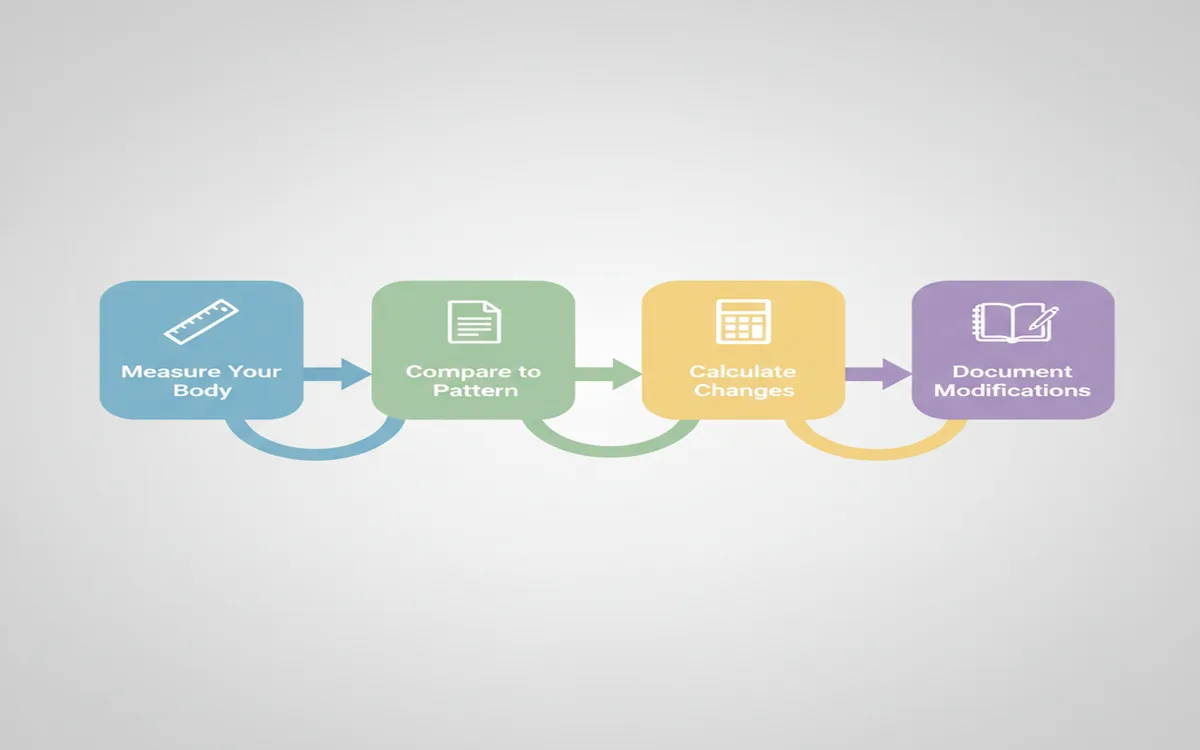
You can adapt any knitting pattern to your size by comparing your body measurements plus ease to the pattern's finished measurements, then adjusting stitch counts proportionally across every section. The process breaks down into three categories: length adjustments (the easiest), width modifications (more involved), and shaping or size blending (the most complex). Whether you're adding 2 inches to a body length or completely regrading a sweater from size Small in the shoulders to size Large in the hips, the same core principle applies — every change to stitches or rows must flow logically through all connected sections. This guide walks you through each type of modification with practical examples, real stitch-count math, and strategies for when adaptation becomes more trouble than it's worth.
Understanding What Needs to Change
Before modifying a single stitch count, you need a clear picture of the gap between the pattern and your body. This diagnostic step saves enormous time and prevents mid-project surprises.
Compare your measurements to the pattern's finished measurements:
- Bust circumference
- Body length (often listed as total length or back length)
- Sleeve length
- Upper arm circumference
- Shoulder width (also called cross-back measurement)
Finished measurements already include ease — that extra room built into a garment so it moves with your body. A pattern might list a 40-inch finished bust for a size that fits a 36-inch actual bust, meaning 4 inches of ease are built in. Before deciding to add stitches, confirm whether the difference between your measurement and the pattern's measurement is a true size mismatch or simply the design's intended ease.
Note each difference:
- Is it a length issue (easily adjusted without recalculating stitch counts)?
- Is it a width issue (more complex, requires reshaping)?
- Is it a shaping issue — where waist shaping sits, how deep the armhole is, how the sleeve cap is drawn (most complex)?
Write these differences down in inches before touching the pattern. A 1-inch difference at the bust means approximately 1 × your stitch gauge stitches to add or remove. A half-inch difference in sleeve length might mean just 4 to 6 extra rows. Quantify everything first.
Length Adjustments: The Easiest Modifications
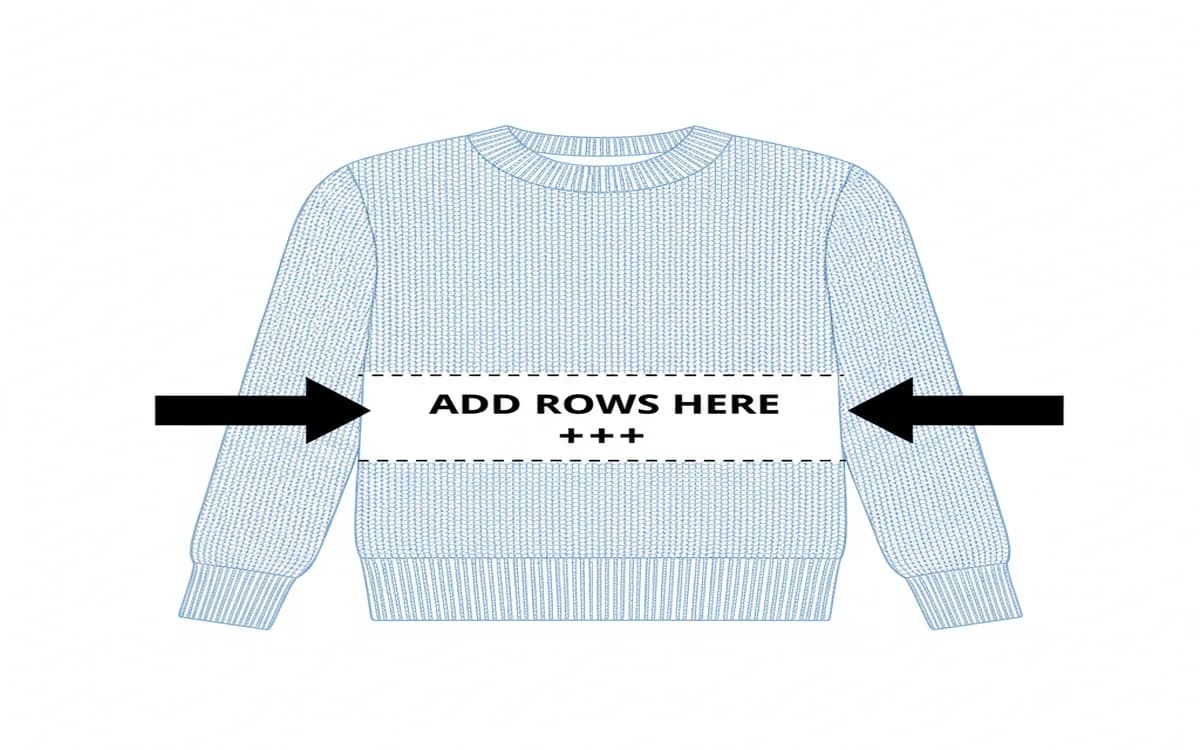
Length changes are the most beginner-friendly modification because they don't affect stitch counts within rows. You are simply adding or removing horizontal rows in a section that has no shaping — the stitch count stays constant throughout.
Body Length
To add length: Work more rows before starting armhole shaping. In a bottom-up sweater, continue knitting the body past the pattern's stated measurement. In a top-down construction, carry on past where the pattern instructs you to begin the underarm bind-off.
To remove length: Work fewer rows. If the pattern says to work 15 inches before the armhole and you need only 13 inches, stop 2 inches early. That's it.
Where to adjust safely:
- Below the armhole, in the plain body section (most common spot)
- Between hip shaping and waist shaping, if the pattern includes waist darts
- Never within active shaping sections — do not compress or extend a section where increases or decreases are already happening
The calculation: Extra inches needed × row gauge (rows per inch) = rows to add or remove. If your row gauge is 8 rows per inch and you need 1.5 more inches, add 12 rows. Simple.
Sleeve Length
Sleeves are equally forgiving when it comes to length. The plain section between the cuff ribbing and the start of sleeve cap shaping (in bottom-up construction) is your adjustment zone.
To add length: Add rows in that plain middle section. To remove length: Subtract rows from the same section.
One important ripple effect: If you change sleeve length significantly — by more than about 1.5 inches — you may need to re-space your sleeve increases. A sleeve that goes from 40 cuff stitches to 72 upper arm stitches requires 16 increases per side. If the original sleeve was 17 inches and yours is 20 inches, those 16 increases need to be spread over more rows. Divide total rows by number of increase events to find your new increase interval. More length means increases spaced further apart. Less length means increases happen more frequently, so check that the interval doesn't become impossibly tight (working an increase every other row for a long stretch, for example).
Torso Proportions
Body proportions vary enormously. If you are long-waisted, you may need to add length between the waist shaping and the underarm. If you are short-waisted, remove rows in that same zone. In both cases, keep the armhole depth unchanged — the armhole is sized to fit your arm opening, not your torso length, and compressing it creates a functional problem, not just an aesthetic one.
Width Adjustments: More Complex
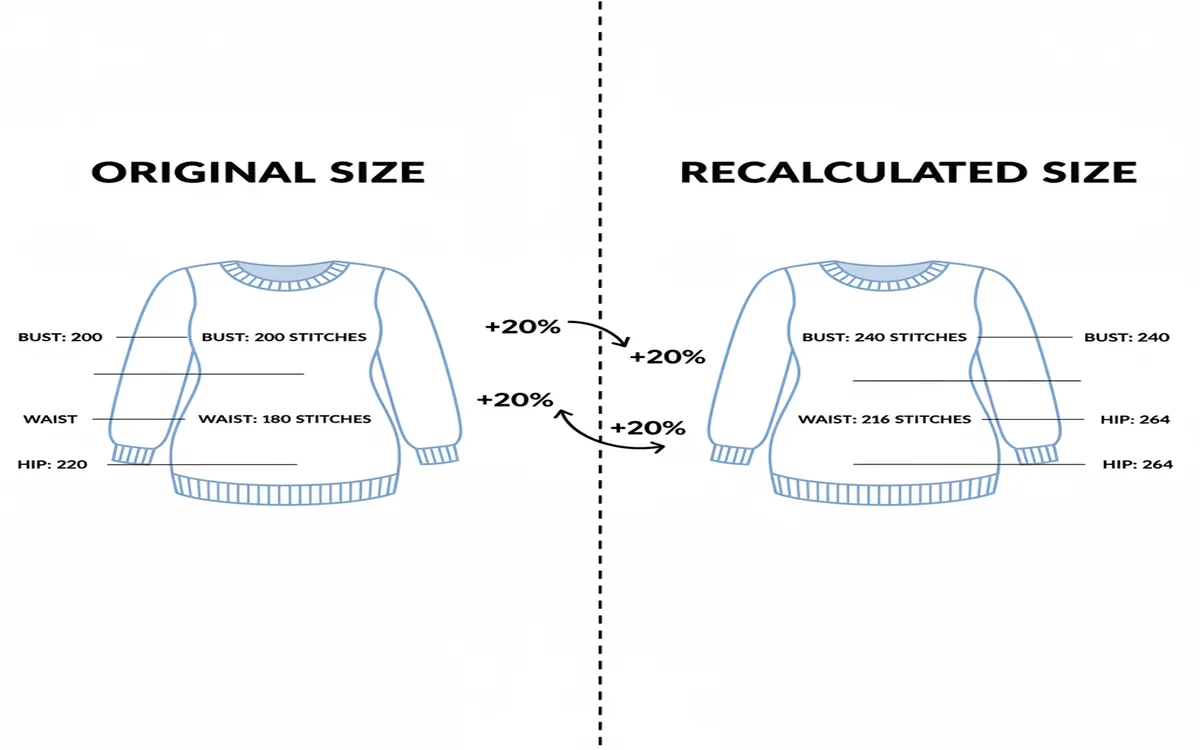
Changing width means changing stitch counts, and stitch counts are woven through every shaping instruction in the pattern. Any addition or subtraction at the cast-on will ripple forward into armhole decreases, shoulder bind-offs, and potentially neck shaping. This is manageable — it just requires methodical recalculation rather than simple row counting.
Adding Width to the Body
At cast on: Add stitches distributed evenly between front and back. If the pattern casts on 200 stitches for a body worked in the round and you need 10% more width, cast on 220 stitches (200 × 1.10 = 220).
Impact on shaping: Every subsequent decrease or bind-off that references the original stitch count must be recalculated. Armhole shaping, for example, typically removes a percentage of the total stitches — often 8 to 12% per side for a standard set-in armhole. If you added 10% more stitches to begin with, add approximately 10% more to your armhole decrease totals. The proportions stay constant even as the raw numbers shift.
Removing Width from the Body
The reverse logic applies. Subtract stitches proportionally at cast-on and reduce all shaping instructions by the same percentage. A useful shorthand: divide your target stitch count by the pattern's stitch count to get a multiplier, then apply that multiplier to every stitch-based instruction. If the pattern's armhole calls for binding off 6 stitches then working 12 decreases per side, and your multiplier is 0.90, your armhole binds off approximately 5 stitches and works 11 decreases per side.
Width at Specific Points
Not every body needs uniform width adjustment. Common localized modifications include:
Fuller bust: Rather than widening the entire garment, add short rows across the center front panel. Short rows create extra fabric at the bust apex without adding circumference at the waist or hips. Typically, 4 to 8 short rows add between half an inch and 1.5 inches of length at center front — enough to prevent the back hem from riding up on a fuller chest.
Broader hips: Add stitches at the hip cast-on and gradually decrease to the original waist stitch count through the body. You are essentially grading between two sizes — hip at size Large, waist at size Medium — within a single garment. Space the decreases evenly over 3 to 5 inches of body length for a smooth transition.
Narrower shoulders: Shoulder width is one of the trickier adjustments because the shoulder seam affects sleeve attachment geometry. One practical approach is to choose the smaller size for the yoke and upper body while adding stitches back into the lower body. Another is to look specifically for patterns using a top-down raglan or seamless yoke construction, where the shoulder width is less rigidly fixed by shaping math.
Sleeve Adjustments
Upper Arm Width
The upper arm is the critical measurement for sleeve fit. A sleeve that is too tight at the bicep is unwearable; one that is too loose looks sloppy. To find your target upper arm stitch count, multiply (upper arm measurement + ease) by your stitch gauge. Compare that number to the pattern's stated upper arm stitch count at the widest point.
Example with real numbers: Your upper arm is 13 inches, you want 2 inches of ease, and your gauge is 5 stitches per inch. Target: 15 inches × 5 = 75 stitches. The pattern's size calls for 70 stitches. You need 5 more stitches — add roughly 2 to 3 increases per side distributed over the sleeve length.
If the pattern goes from 40 cuff stitches to 70 upper arm stitches, that is 30 total increases (15 per side). To reach 75, work 17 to 18 increases per side instead, spread over the same sleeve length.
Cap Shaping (Set-In Sleeves)
The sleeve cap is the curved top of the sleeve that fits into the armhole opening. Its circumference must match the armhole circumference within about half an inch, or the sleeve will pucker or pull. If you changed the upper arm stitch count, recalculate the cap accordingly:
- More stitches at upper arm = more stitches to bind off and decrease through the cap
- The cap height is typically 50 to 60% of the armhole depth — keep this ratio intact
- The rate of decreases shapes the curve; work paired decreases more frequently at the cap edges and leave a flatter section at the top
Set-in sleeve caps are the most mathematical part of garment knitting. If this level of calculation feels overwhelming, consider choosing patterns with raglan, saddle shoulder, or drop-shoulder construction — all of which are significantly more forgiving of stitch count changes and less dependent on precise geometric matching.
Working Between Sizes
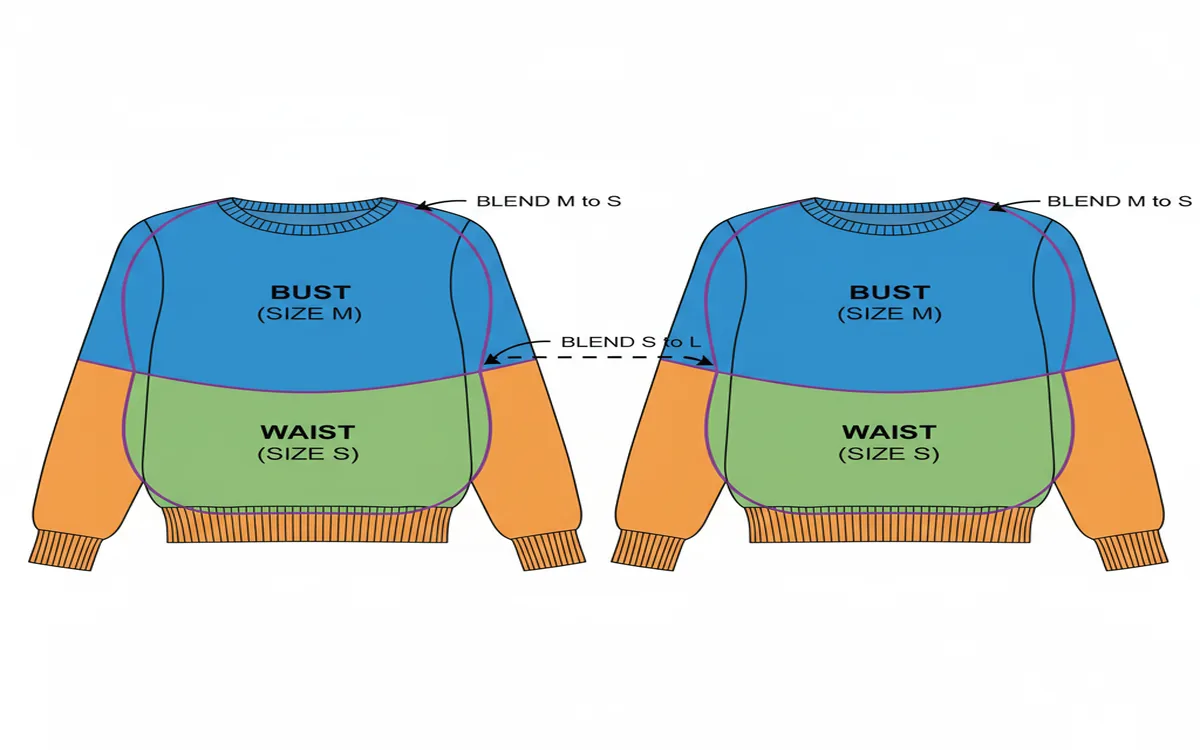
Most knitters do not fit neatly into one pattern size. Bodies are not standardized, and pattern sizing rarely accounts for the full range of proportions. If your measurements land between sizes or across sizes in different body zones, you have two main strategies. And if no size in the pattern comes close to your numbers, our guide on how to resize a knitting pattern covers the full recalculation.
Blend Sizes
Follow size Medium for the bust and upper body, size Large for the hips and lower body. This is called "size blending" or "grading between sizes" and is a standard technique in professional knitwear design.
Mark your pattern copy clearly — use different colored pens or highlighters to show which size you are following in each section. Label transition points explicitly. At the point where the hip section ends and the waist section begins, you may need to add or remove a few stitches over several rows to bridge from the Large hip count to the Medium waist count gracefully. A gradual transition over 2 inches (roughly 16 rows at a typical row gauge) reads as smooth shaping rather than an abrupt change.
Interpolate Between Sizes
If size Medium is 200 stitches and size Large is 220 stitches, and your calculation says you need 210, simply cast on 210. Adjust every proportional instruction by the same ratio: you are 50% of the way between Medium and Large, so your armhole decreases, shoulder bind-offs, and neck shaping should also sit halfway between the two sizes' instructions. This works cleanly when the two sizes are close together. When sizes are far apart, blending (following each size where it best fits your body) tends to give more accurate results.
Documenting Your Changes
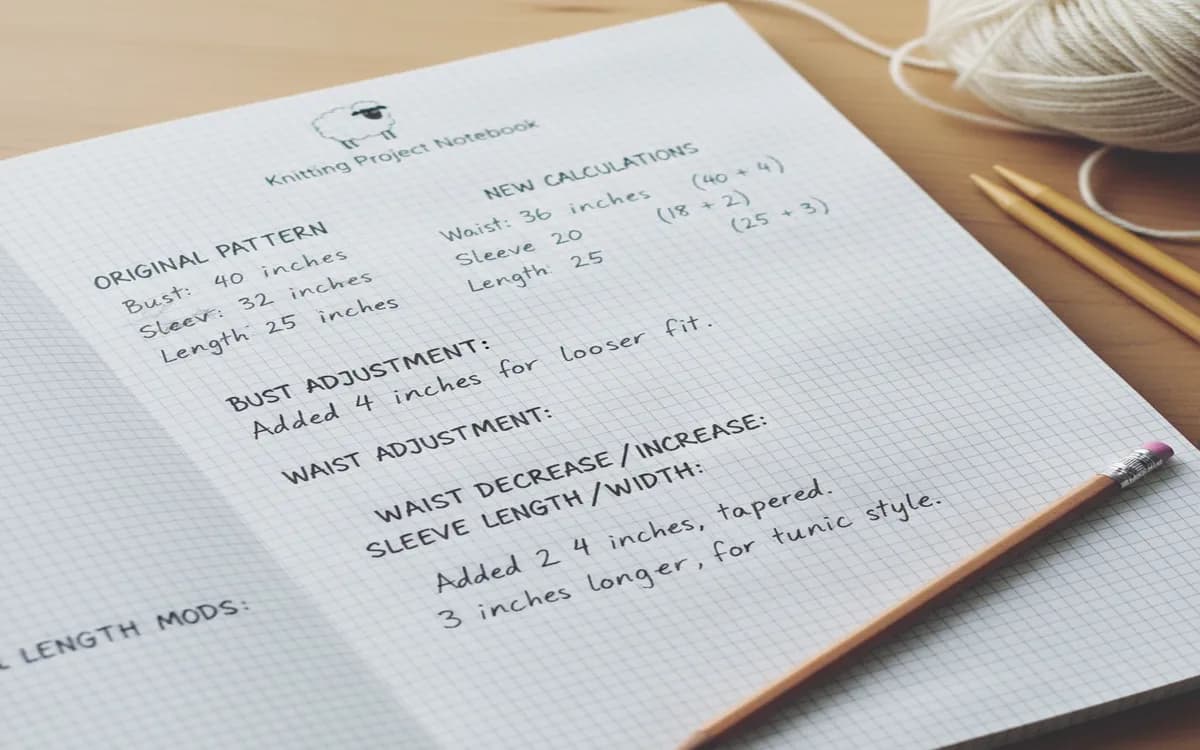
This step is non-negotiable if you want to reproduce a successful fit or troubleshoot a problem. Before casting on, write out every modification in a single reference document:
- New stitch counts for cast-on, waist, bust, armhole, shoulder, and neckline
- Adjusted shaping instructions with row-by-row breakdown where needed
- Row counts for all length changes
- Notes on which size you followed in each section (if blending)
- Your gauge swatch results — both stitch gauge and row gauge, measured over at least 4 inches
Keep this document with your project. When the sweater fits beautifully, you will have a complete record to reuse. When something needs fixing, you will know exactly what you did and where to adjust.
Using Technology for Adaptations
Pattern adaptation requires systematic math and sustained attention to detail. If spreadsheet calculations are not your strength, several tools can assist.
Spreadsheets: Build a template with your gauge entered as variables. Formulas can automatically calculate stitch counts for any measurement you enter, making it easy to see the impact of a change across all sections simultaneously.
Pattern adjustment calculators: Various online tools assist with specific modifications like sleeve cap math or ease calculations. These are particularly useful for set-in sleeve geometry.
Custom pattern generation: Tools like La Maille sidestep the modification problem entirely by generating a pattern built around your specific measurements and gauge from the outset. Instead of adapting a standard-size pattern to fit, you start with one designed for your body — no conversion math required. This is especially valuable when your measurements differ significantly from standard sizing in multiple areas at once.
When Adaptation Gets Too Complex
Not every modification is worth attempting. Some are genuinely difficult and time-consuming even for experienced knitters:
- Significantly changing shoulder width without restructuring the yoke
- Converting between construction methods (top-down to bottom-up, set-in to raglan)
- Modifying colorwork patterns where stitch repeats must divide perfectly into the total stitch count
- Adjusting heavily textured stitch patterns with complex multiples
- Reworking highly shaped garments with multiple simultaneous shaping elements
When you encounter this level of complexity, weigh the cost honestly. It may be more efficient to find a pattern that starts closer to your measurements, use the design as pure inspiration and draft from scratch, or generate a custom pattern from a reference image using a tool like La Maille.
The goal is a garment that fits — not a perfect display of mathematical endurance.
Practical Starting Strategy
Build your modification skills incrementally rather than attempting a full multi-zone regrading on your first attempt:
1. Start with length adjustments only — pick a pattern close to your width measurements and just lengthen or shorten where needed 2. Try width adjustments on a forgiving silhouette — drop-shoulder and boxy-fit sweaters have minimal shaping math, making width changes much simpler than fitted styles 3. Attempt size blending once you are comfortable with both length and width modifications separately 4. Work toward full custom adaptation — adjusting every section proportionally to your measurements
Each project that fits well builds both confidence and a practical reference library for future knitting.
Frequently Asked Questions
How do I adapt a pattern for my size? Start by taking your full body measurements — bust, waist, hips, upper arm, body length, and sleeve length. Compare each to the pattern's finished measurements (which already include ease). Calculate the difference in inches, then convert to stitches or rows using your gauge: inches × stitch gauge = stitches, inches × row gauge = rows. Apply changes section by section, recalculating shaping instructions proportionally wherever stitch counts have changed. Document everything before you cast on.
Can I mix sizes within a pattern? Yes — following one size for the lower body and another for the upper body is a standard professional technique called size blending or multi-size grading. Mark your pattern clearly so you know which size you are following in each section. At transition points where sizes meet, plan a gradual shift — add or remove stitches over 2 to 3 inches of fabric rather than all at once, so the transition reads as smooth shaping.
What's the easiest pattern modification? Length adjustments are the simplest change you can make. Adding or removing rows in a plain, unshaped section requires no stitch count recalculation — you simply knit more or fewer rows before beginning the next shaping event. Width changes require recalculating armhole decreases, shoulder bind-offs, and potentially neck shaping, which is significantly more involved.
When should I generate a custom pattern instead of adapting? When your measurements differ from standard sizing in multiple areas simultaneously, when you consistently experience fit problems with standard patterns across multiple projects, or when the complexity of required modifications would take longer than the knitting itself. Custom-generated patterns are also worth considering when working with expensive yarn where you want to minimize the risk of a poor fit.
How do I calculate sleeve increases after modifying the upper arm stitch count? Take your target upper arm stitch count minus your cuff stitch count, then divide by 2 to get the number of increases needed per side. Divide the total number of rows in the sleeve (from end of cuff ribbing to start of cap shaping) by the number of increase events per side to find your increase interval. For example, if you need 18 increases per side over 120 rows, work an increase every 6 to 7 rows, alternating between the two intervals to distribute them evenly.
What ease should I add before comparing measurements? Ease varies by garment style. A fitted sweater typically uses 0 to 2 inches of positive ease at the bust. A standard classic-fit pullover uses 2 to 4 inches. An oversized style uses 4 to 8 inches or more. Check the pattern's schematic against its size chart — the difference between the size label's body measurement and the finished garment measurement tells you exactly how much ease the designer built in. If that matches your preference, focus only on fit differences, not ease differences.